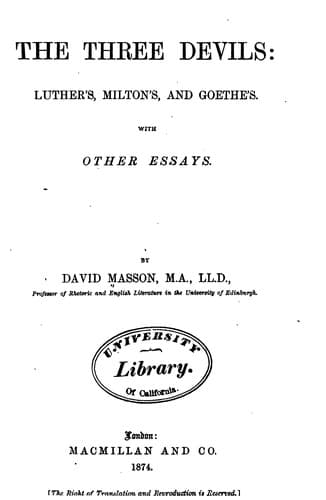
The Three Devils: Luther's, Milton's, and Goethe's; With Other EssaysMasson, David
History
The Three Devils: Luther's, Milton's, and Goethe's; With Other Essays
Masson, David
Devil in literature; Literature -- History and criticism
The death of Vanessa in 1722 left Swift from that time entirely Stella's.
How she got over the Vanessa affair in her own mind, when the full extent
of the facts became known to her, can only be guessed. When some one
alluded to the fact that Swift had written beautifully about Vanessa, she
is reported to have said "That doesn't signify, for we all know the Dean
could write beautifully about a broomstick." "A woman, a true woman!" is
Mr. Thackeray's characteristic comment.
To the world's end those who take interest in Swift's life will range
themselves either on the side of Stella or on that of Vanessa. Mr.
Thackeray prefers Stella, but admits that, in doing so, though the
majority of men may be on his side, he will have most women against him.
Which way Swift's _heart_ inclined him it is not difficult to see. Stella
was the main influence of his life; the intimacy with Vanessa was but an
episode. And yet, when he speaks of the two women as a critic, there is a
curious equality in his appreciation of them. Of Stella he used to say
that her wit and judgment were such that "she never failed to say the best
thing that was said wherever she was in company;" and one of his
epistolary compliments to Vanessa is that he had "always remarked that,
neither in general nor in particular conversation, had any word ever
escaped her lips that could by possibility have been better." Some little
differences in his preceptorial treatment of them may be discerned--as
when he finds it necessary to admonish poor Stella for her incorrigibly
bad spelling, no such admonition, apparently, being required for Vanessa;
or when, in praising Stella, he dwells chiefly on her honour and gentle
kindliness, whereas in praising Vanessa he dwells chiefly on her genius
and force of mind. But it is distinctly on record that his regard for both
was founded on his belief that in respect of intellect and culture both
were above the majority of their sex. And here it may be repeated that,
not only from the evidence afforded by the whole story of Swift's
relations to these two women, but also from the evidence of distinct
doctrinal passages scattered through his works, it appears that those who
in the present day maintain the co-equality of the two sexes, and the
right of women to as full and varied an education, and as free a social
use of their powers, as is allowed to men, may claim Swift as a pioneer in
their cause. Both Stella and Vanessa have left their testimony that from
the very first Swift took care to indoctrinate them with peculiar views on
this subject; and both thank him for having done so. Stella even goes
further, and almost urges Swift to do on the great scale what he had done
for her individually:--
"O turn your precepts into laws;
Redeem the woman's ruin'd cause;
Retrieve lost empire to our sex,
That men may bow their rebel necks."
Public-domain text, read in full here on John Shaqi.
Reviews
Reviews
No reviews yet
Be the first to share your thoughts on this work.
Elsewhere in the archive
Join the Discussion
Join the discussion
Sign in to leave a comment or review.
Sign InorCreate an account