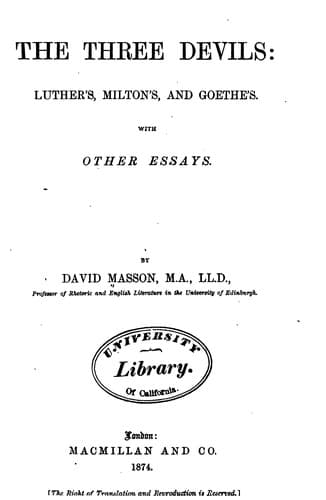
The Three Devils: Luther's, Milton's, and Goethe's; With Other EssaysMasson, David
History
The Three Devils: Luther's, Milton's, and Goethe's; With Other Essays
Masson, David
Devil in literature; Literature -- History and criticism
This fact that Swift had a _theory_ on the subject of the proper mode of
treating and educating women, which theory was in antagonism to the ideas
of his time, explains much both in his conduct as a man and in his habits
as a writer.
* * * * *
For the first six years of his exile in Ireland after the death of Queen
Anne, Swift had published nothing of any consequence, and had kept aloof
from politics, except when they were brought to his door by local
quarrels. In 1720, however, he again flashed forth as a political
luminary, in a character that could hardly have been anticipated--that of
an Irish patriot. Taking up the cause of the "scoundrel-island," to which
he belonged by birth, if not by affection, and to which fate had consigned
him in spite of all his efforts, he made that cause his own. Virtually
saying to his old Whig enemies, then in power on the other side of the
water, "Yes, I am an Irishman, and I will show you what an Irishman is,"
he constituted himself the representative of the island, and hurled it,
with all its pent-up mass of rage and wrongs, against Walpole and his
administration. First, in revenge for the commercial wrongs of Ireland
came his _Proposal for the Universal Use of Irish Manufactures, utterly
Rejecting and Renouncing Everything Wearable that comes from England_;
then, amidst the uproar and danger excited by this proposal, other and
other defiances in the same tone; and lastly, in 1723, on the occasion of
the royal patent to poor William Wood to supply Ireland, without her own
consent, with a hundred and eight thousand pounds' worth of copper
half-pence of English manufacture, the unparalleled _Drapier's Letters_,
which blasted the character of the coppers and asserted the nationality of
Ireland. All Ireland, Catholic as well as Protestant, blessed the Dean of
St. Patrick's; associations were formed for the defence of his person;
and, had Walpole and his Whigs succeeded in bringing him to trial, it
would have been at the expense of an Irish rebellion. From that time till
his death Swift was the true King of Ireland; only when O'Connell arose
did the heart of the nation yield equal veneration to any single chief;
and even at this day the grateful Irish, forgetting his gibes against
them, and forgetting his continual habit of distinguishing between the
Irish population as a whole and the English and Protestant part of it to
which he belonged himself, cherish his memory with loving enthusiasm, and
speak of him as the "great Irishman." Among the phases of Swift's life
this of his having been an Irish patriot and agitator deserves to be
particularly remembered.
Public-domain text, read in full here on John Shaqi.
Reviews
Reviews
No reviews yet
Be the first to share your thoughts on this work.
Elsewhere in the archive
Join the Discussion
Join the discussion
Sign in to leave a comment or review.
Sign InorCreate an account