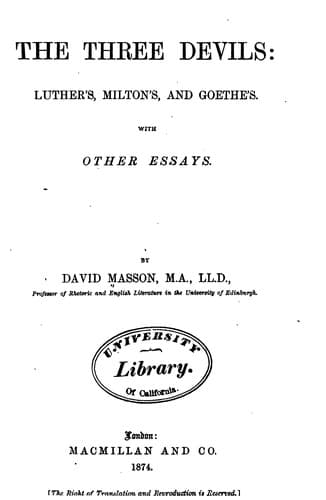
The Three Devils: Luther's, Milton's, and Goethe's; With Other EssaysMasson, David
History
The Three Devils: Luther's, Milton's, and Goethe's; With Other Essays
Masson, David
Devil in literature; Literature -- History and criticism
In the year 1726 Swift, then in his sixtieth year, and in the full flush
of his new popularity as the champion of Irish nationality, visited
England for the first time since Queen Anne's death. Once there, he was
loth to return; and a considerable portion of the years 1726 and 1727 was
spent by him in or near London. This was the time of the publication of
_Gulliver's Travels_, which had been written some years before, and also
of some _Miscellanies_, which were edited for him by Pope. It was at
Pope's villa at Twickenham that most of his time was spent; and it was
there and at this time that the long friendship between Swift and Pope
ripened into that extreme and affectionate intimacy which they both lived
to acknowledge. Gay, Arbuthnot, and Bolingbroke, now returned from exile,
joined Pope in welcoming their friend. Addison had been dead several
years. Prior was dead, and also Vanbrugh and Parnell. Steele was yet
alive; but between him and Swift there was no longer any tie. Political
and aristocratic acquaintances, old and new, there were in abundance, all
anxious once again to have Swift among them to fight their battles. Old
George I. had not long to live, and the Tories were trying again to come
into power in the train of the Prince of Wales. There were even chances of
an arrangement with Walpole, with possibilities, in that or in some other
way, that Swift should not die a mere Irish dean. These prospects were but
temporary. The old King died; and, contrary to expectation, George II.
retained Walpole and his Whig colleagues. In October, 1727, Swift left
England for the last time. He returned to Dublin just in time to watch
over the death-bed of Stella, who expired, after a lingering illness, in
January, 1728. Swift was then in his sixty-second year.
* * * * *
The story of the remaining seventeen years of Swift's life--for, with all
his maladies, bodily and mental, his strong frame withstood, for all that
time of solitude and gloom, the wear of mortality--is perhaps better known
than any other part of his biography. How his irritability and
eccentricities and avarice grew upon him, so that his friends and servants
had a hard task in humouring him, we learn from the traditions of others;
how his memory began to fail, and other signs of breaking-up began to
appear, we learn from himself;--
"See how the Dean begins to break!
Poor gentleman he droops apace;
You plainly find it in his face.
That old vertigo in his head
Will never leave him till he's dead.
Besides, his memory decays;
He recollects not what he says;
He cannot call his friends to mind,
Forgets the place where last he dined,
Plies you with stories o'er and o'er;
He told them fifty times before."
Public-domain text, read in full here on John Shaqi.
Reviews
Reviews
No reviews yet
Be the first to share your thoughts on this work.
Elsewhere in the archive
Join the Discussion
Join the discussion
Sign in to leave a comment or review.
Sign InorCreate an account