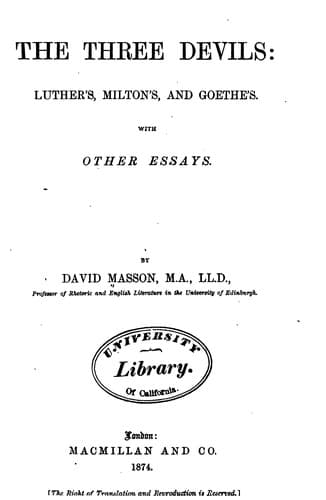
The Three Devils: Luther's, Milton's, and Goethe's; With Other EssaysMasson, David
History
The Three Devils: Luther's, Milton's, and Goethe's; With Other Essays
Masson, David
Devil in literature; Literature -- History and criticism
"His understanding having totally failed soon after these melancholy
expressions of grief and affection, his first state was that of
violent and furious lunacy. His estate was put under the management
of trustees, and his person confided to the care of Dr. Lyons, a
respectable clergyman, curate to the Rev. Robert King, prebendary of
Dunlavin, one of Swift's executors. This gentleman discharged his
melancholy task with great fidelity, being much and gratefully
attached to the object of his care. From a state of outrageous
frenzy, aggravated by severe bodily suffering, the illustrious Dean
of St. Patrick's sank into the situation of a helpless changeling. In
the course of about three years he is only known to have spoken once
or twice. At length, when this awful moral lesson had subsisted from
1743 until the 19th of October, 1745, it pleased God to release him
from this calamitous situation. He died upon that day without a
single pang, so gently that his attendants were scarce aware of the
moment of his dissolution."
Swift was seventy-eight years of age at the time of his death, having
outlived all his contemporaries of the Queen Anne cluster of wits, with
the exception of Bolingbroke, Ambrose Philips, and Cibber. Congreve had
died in 1729; Steele in the same year; Defoe in 1731; Gay in 1732;
Arbuthnot in 1735; Tickell in 1740; and Pope, who was Swift's junior by
twenty-one years, in 1744. Swift, therefore, is entitled in our literary
histories to the place of patriarch as well as to that of chief among the
Wits of Queen Anne's reign; and he stands nearest to our own day of any of
them whose writings we still read. As late as the year 1820 a person was
alive who had seen Swift as he lay dead in the deanery before his burial,
great crowds going to take their last look of him. "The coffin was open;
he had on his head neither cap nor wig; there was not much hair on the
front or very top, but it was long and thick behind, very white, and was
like flax upon the pillow." Such is the last glimpse we have of Swift on
earth. Exactly ninety years afterwards the coffin was taken up from its
resting-place in the aisle of the cathedral; and the skull of Swift, the
white locks now all mouldered away from it, became an object of
scientific curiosity. Phrenologically, it was a disappointment, the
extreme lowness of the forehead striking everyone, and the so-called
organs of wit, causality, and comparison being scarcely developed at all.
There were peculiarities, however, in the shape of the interior,
indicating larger capacity of brain than would have been inferred from the
external aspect. Stella's coffin was exhumed, and her skull examined at
the same time. The examiners found the skull "a perfect model of symmetry
and beauty."
* * * * *
Public-domain text, read in full here on John Shaqi.
Reviews
Reviews
No reviews yet
Be the first to share your thoughts on this work.
Elsewhere in the archive
Join the Discussion
Join the discussion
Sign in to leave a comment or review.
Sign InorCreate an account