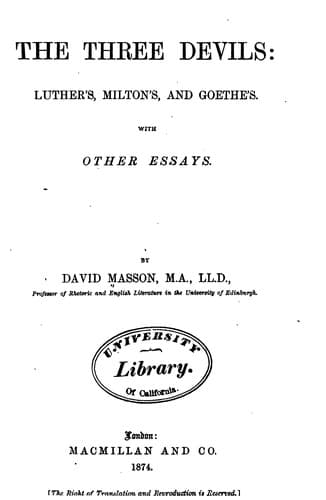
The Three Devils: Luther's, Milton's, and Goethe's; With Other EssaysMasson, David
History
The Three Devils: Luther's, Milton's, and Goethe's; With Other Essays
Masson, David
Devil in literature; Literature -- History and criticism
Have we said too much in declaring that of all the men who illustrated
that period of our literary history which lies between the Revolution of
1688 and the beginning or middle of the reign of George II. Swift alone
(Pope excepted, and he only on certain definite and peculiar grounds)
fulfils to any tolerable extent those conditions which would entitle him
to the epithet of "great," already refused to his age as a whole? We do
not think so. Swift _was_ a great genius; nay, if by _greatness_ we
understand general mass and energy rather than any preconceived
peculiarity of quality, he was the greatest genius of his age. Neither
Addison, nor Steele, nor Pope, nor Defoe, possessed, in anything like the
same degree, that which Goethe and Niebuhr, seeking a name for a certain
attribute found often present, as they thought, in the higher and more
forcible order of historic characters, agreed to call the _demonic_
element. Indeed very few men in our literature, from first to last, have
had so much of this element in them--perhaps the sign and source of all
real greatness--as Swift. In him it was so obvious as to attract notice at
once. "There is something in your looks," wrote Vanessa to him, "so awful
that it strikes me dumb;" and again, "Sometimes you strike me with that
prodigious awe I tremble with fear;" and again, "What marks are there of a
deity that you are not known by?" True, these are the words of a woman
infatuated with love; but there is evidence that, wherever Swift went, and
in whatever society he was, there was this magnetic power in his presence.
Pope felt it; Addison felt it; they all felt it. We question if, among all
our literary celebrities, from first to last, there has been one more
distinguished for being personally formidable to all who came near him.
And yet, in calling Swift a great genius, we clearly do not mean to rank
him in the same order of greatness with such men among his predecessors as
Spenser, or Shakespeare, or Milton, or such men among his successors as
Scott, Coleridge, and Wordsworth. We even retain instinctively the right
of not according to him a certain kind of admiration which we bestow on
such men of his own generation as Pope, Steele, and Addison. How is this?
What is the drawback about Swift's genius which prevents us from
referring him to that highest order of literary greatness to which we do
refer others who in respect of hard general capacity were apparently not
superior to him, and on the borders of which we also place some who in
that respect were certainly his inferiors? To make the question more
special, why do we call Milton great in quite a different sense from that
in which we consent to confer the same epithet on Swift?
Public-domain text, read in full here on John Shaqi.
Reviews
Reviews
No reviews yet
Be the first to share your thoughts on this work.
Elsewhere in the archive
Join the Discussion
Join the discussion
Sign in to leave a comment or review.
Sign InorCreate an account