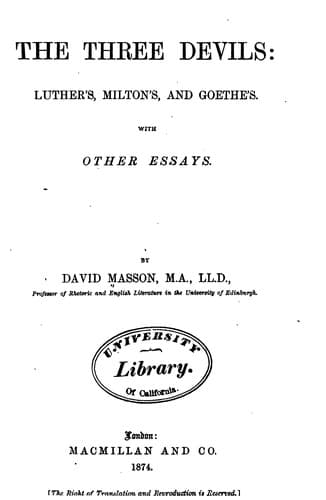
The Three Devils: Luther's, Milton's, and Goethe's; With Other EssaysMasson, David
History
The Three Devils: Luther's, Milton's, and Goethe's; With Other Essays
Masson, David
Devil in literature; Literature -- History and criticism
thinking," "mode of feeling and thinking," "habit of thought," "moral and
intellectual character or constitution," and the like. Or, again, if we
will have an image of that which from its nature is unimaginable, then, in
our efforts to be as pure and abstract as possible, we find ourselves
driven, as I have said, into a fancy of mind as a kind of clear aërial
transparency, unbounded or of indefinite bounds, and yet not a dead
transparency, but a transparency full of pulses, powers, motions, and
whirls, capable in a moment of clouding itself, ceasing to be a
transparency, and becoming some strange solid phantasmagory, as of a
landscape smiling in sunshine or a sky dark with a storm. Yet again there
is another and more mechanical conception of mind which may be of
occasional use. The thinking power, the thinking principle, the substance
which feels and thinks, are phrases for mind from of old: what if we were
to agree, for a momentary advantage, to call mind rudely the thinking
apparatus? What the advantage may be will presently appear.
Mind, mode of thinking, mode of thinking and feeling, moral and
intellectual constitution, that mystic transparency full of pulses and
motions, this thinking apparatus,--whichever phrase or image we adopt,
there are certain appertaining considerations which we have to take along
with us.
(1.) There is the consideration of differences of degree, quality, and
worth. Mind may be great or small, noble or mean, strong or weak; the mode
of thinking of one person or one time may be higher, finer, grander than
that of another; the moral and intellectual constitutions of diverse
individuals or peoples may present all varieties of the admirable and
lovely or the despicable and unlovely; the pulses and motions in that
mystic transparency which we fancy as one man's mind may be more vehement,
more awful, more rhythmical and musical, than are known in that which we
fancy as the mind of some other; the thinking apparatus which A possesses,
and by which he performs the business of his life, may be more massive,
more complex, more exquisite, capable of longer reaches and more superb
combinations, than that which has fallen to the lot of B. All this is
taken for granted everywhere; all our speech and conduct proceed on the
assumption.
Public-domain text, read in full here on John Shaqi.
Reviews
Reviews
No reviews yet
Be the first to share your thoughts on this work.
Elsewhere in the archive
Join the Discussion
Join the discussion
Sign in to leave a comment or review.
Sign InorCreate an account