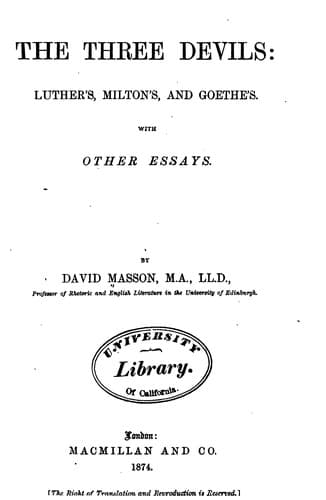
The Three Devils: Luther's, Milton's, and Goethe's; With Other EssaysMasson, David
History
The Three Devils: Luther's, Milton's, and Goethe's; With Other Essays
Masson, David
Devil in literature; Literature -- History and criticism
reminding us thereof by its structure through and through, and by a crust
of innumerable allusions. It has been remarked by Hallam, and by others,
how particularly useful in this way for the historian, as furnishing him
with social details of past times, are popular books more especially of
the humorous order--comic dramas and farces, poems of occasion, and novels
and works of prose-fiction generally. How the plays of Aristophanes admit
us to the public life of Athens! How, as we read the Satires and Epistles
of Horace, we see old Rome, like another huge London, only with taller
houses, and the masons mending the houses, and the poet himself, like a
modern official in Somerset House, trudging along to his office, jostled
by the crowds, and having to get out of the way of the ladders and the
falling rubbish, thinking all the while of his appointment with Mæcenas!
Or, if it is the reign of George II. in Britain that we are studying,
where shall we find better illustration of much of the life, and
especially the London life, of that coarse, wig-wearing age, than in the
novels of Fielding and Smollett?
* * * * *
These, and perhaps other ways in which Literature may illustrate History,
are tolerably obvious, and need no farther exposition. There is, however,
a higher and somewhat more subtle service which Literature may perform
towards illustrating History and modifying our ideas of the Past.
What the historian chiefly and finally wants to get at, through all his
researches, and by all his methods of research, is the _mind_ of the time
that interests him, its mode of thinking and feeling. Through all the
trappings, all the colours, all the costumes, all those circumstances of
the picturesque which delight us in our recollections of the past, this is
what we seek, or ought to seek. The trappings and picturesque
circumstances are but our optical helps in our quest of this; they are the
thickets of metaphor through which we push the quest, interpreting as we
go. The metaphors resolve themselves; and at last it is as if we had
reached that vital and essential something--a clear transparency, we seem
to fancy it, and yet a kind of throbbing transparency, a transparency
with pulses and powers--which we call the mind or spirit of the time. As
in the case of the individual, so in that of a time or a people, we seem
to have got at the end of our language when we use this word, mind or
spirit. We know what we mean, and it is the last thing that we can mean;
but, just on that account, it eludes description or definition. At best we
can go to and fro among a few convenient synonyms and images. Soul, mind,
spirit, these old and simple words are the strongest, the profoundest, the
surest; age cannot antiquate them, nor science undo them; they last with
the rocks, and still go beyond. But, having in view rather the operation
than the cause, we find a use also in such alternative phrases as "mode of
Public-domain text, read in full here on John Shaqi.
Reviews
Reviews
No reviews yet
Be the first to share your thoughts on this work.
Elsewhere in the archive
Join the Discussion
Join the discussion
Sign in to leave a comment or review.
Sign InorCreate an account