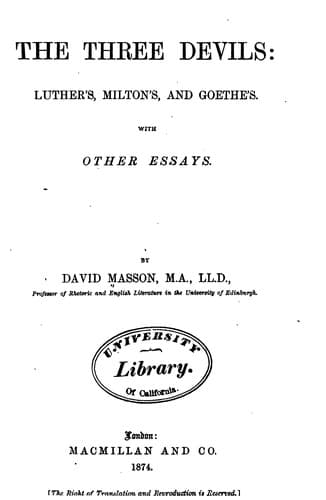
The Three Devils: Luther's, Milton's, and Goethe's; With Other EssaysMasson, David
History
The Three Devils: Luther's, Milton's, and Goethe's; With Other Essays
Masson, David
Devil in literature; Literature -- History and criticism
results, how is it possible to call mind the same as it was a generation
or two ago, when the sciences were fewer, their industry more leisurely,
and their discoveries less frequent? Nay, but we may go back not a
generation or two only, but to generation beyond generation through a long
series, still, as we ascend, finding the sciences fewer, earth's load of
knowledge lighter, and man's very imagination of the physical universe
which he tenants cruder and more diminutive. Till two hundred years ago
the Mundus, or physical system of things, to even the most learned of men,
with scarcely an exception, was a finite spectacular sphere, or succession
of spheres, that of the fixed stars nearly outermost, wheeling round the
central earth for her pleasure; as we penetrate through still prior
centuries, even this finite spherical Mundus is seen to shrink and shrink
in men's fancies of it till a radius of some hundreds of miles would sweep
from the earth to the starry roof; back beyond that again the very notion
of sphericity disappears, and men were walking, as it seemed, on the upper
side of a flat disc, close under a concave of blue, travelled by fiery
caprices. How is it possible to regard man's mode of thinking and
feeling, man's mind, as in any way constant through such vicissitude in
man's notions respecting his very housing in space, and the whole
encircling touch of his physical belongings?
(3.) A third consideration, however, administers a kind of corrective to
the last. It is that, though the last consideration is not unimportant,
its importance practically, and as far as the range of historic time is
concerned, may be easily exaggerated. We have supposed a person betaking
himself to the study of geology, and have truly said that his very mode of
thinking would be thereby affected, that his geological knowledge would
pass into his reason, and determine so far the very cast of his mind, the
form of his ability. Well, but he might have betaken himself to something
else; and who can tell, without definite investigation, but that out of
that something else he might have derived as much increase of his mental
power, or even greater? There are thousands of employments for all minds,
and, though all may select, and select differently, there are thousands
for all in common. Life itself, all the inevitable activity of life, is
one vast and most complex schooling. Books or no books, sciences or no
sciences, we live, we look, we love, we laugh, we fear, we hate, we
wonder; we are sons, we are brothers, we have friends; the seasons return,
the sun shines, the moon walks in beauty, the sea roars and beats the
land, the winds blow, the leaves fall; we are young, we grow old; we
commit others to their graves, we see somewhere the little grassy mound
which shall conceal ourselves:--is not this a large enough primary school
for all and sundry; are not these sufficient and everlasting rudiments?
That so it is we all recognise.
Public-domain text, read in full here on John Shaqi.
Reviews
Reviews
No reviews yet
Be the first to share your thoughts on this work.
Elsewhere in the archive
Join the Discussion
Join the discussion
Sign in to leave a comment or review.
Sign InorCreate an account