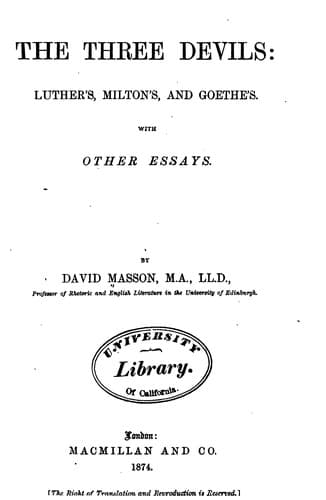
The Three Devils: Luther's, Milton's, and Goethe's; With Other EssaysMasson, David
History
The Three Devils: Luther's, Milton's, and Goethe's; With Other Essays
Masson, David
Devil in literature; Literature -- History and criticism
Given some original force or goodness of
nature, and out of even this primary school, and from the teaching of
these common rudiments, may there not come, do there not come, minds
worthy of mark--the shrewd, keen wit, the upright and robust judgment, the
disposition tender and true, the bold and honest man? And though, for
perfection, the books and the sciences must be superadded, yet do not the
rudiments persist in constant over-proportion and incessant compulsory
repetition through all the process of culture, and is not the great result
of culture itself a reaction on the rudiments? And so, without prejudice
to our foregone conclusion that mind is variable with knowledge, that
every new science or body of notions conquered for the world modifies the
world's mode of thinking and feeling, alters the cast and the working
trick of its reason and imagination, we can yet fall back, for historic
time at least, on the notion of a human mind so essentially permanent and
traditional that we cannot decide by mere chronology where we may justly
be fondest of it, and certainly cannot assume that its latest individual
specimens, with all their advantages, are necessarily the ablest, the
noblest, or the cleverest. In fact, however we may reconcile it with our
theories of vital evolution and progressive civilization, we all
instinctively agree in this style of sentiment. Shakespeare lived and
died, we may say, in the pre-scientific period; he lived and died in the
belief of the fixedness of our earth in space and the diurnal wheeling
round her of the ten spectacular spheres. Not the less was he Shakespeare;
and none of us dares to say that there is now in the world, or has
recently been, a more superb thinking apparatus of its order than his mind
was, a spiritual transparency of larger diameter, or vivid with grander
gleamings and pulses. Two hundred and fifty years, therefore, chock-full
though they are of new knowledges and discoveries, have not been a single
knife-edge of visible advance in the world's power of producing splendid
individuals; and, if we add two hundred and fifty to that, and again two
hundred and fifty, and four times two hundred and fifty more without
stopping, still we cannot discern that there has been a knife-edge of
advance in that particular. For at this last remove we are among the
Romans, and beyond them there lie the Greeks; and side by side with both,
and beyond both, are other Mediterranean Indo-Europeans, and, away in
Asia, clumps and masses of various Orientals. For ease of reference, let
us go no farther than the Greeks. Thinking apparatuses of first-rate grip!
mental transparencies of large diameter and tremulous with great powers
and pulses! What do we say to Homer, Plato, Æschylus, Sophocles,
Euripides, Aristophanes, Thucydides, Aristotle, Demosthenes, and the rest
of the great Hellenic cluster which these represent! True, their cosmology
was in a muddle (perhaps _ours_ is in a muddle too, for as little as we
Public-domain text, read in full here on John Shaqi.
Reviews
Reviews
No reviews yet
Be the first to share your thoughts on this work.
Elsewhere in the archive
Join the Discussion
Join the discussion
Sign in to leave a comment or review.
Sign InorCreate an account