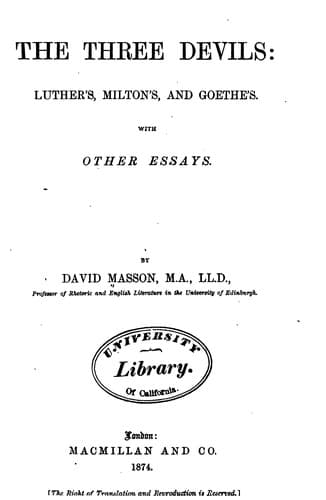
The Three Devils: Luther's, Milton's, and Goethe's; With Other EssaysMasson, David
History
The Three Devils: Luther's, Milton's, and Goethe's; With Other Essays
Masson, David
Devil in literature; Literature -- History and criticism
The Fourteenth Century in our island was not what we should now hold up as
a model age, a soft age, an orderly age, an instructed age, a pleasant age
for a lady or gentleman that has been accustomed to modern ideas and
modern comforts to be transferred back into. It was the age of the three
first Edwards, Richard II., and Henry IV. in England, and of the Wallace
Interregnum, Bruce, David II., and the two first Stuarts in Scotland. Much
was done in it, as these names will suggest, that has come down as
picturesque story and stirring popular legend. It is an age, on that
account, in which schoolboys and other plain uncritical readers of both
nations revel with peculiar relish. Critical inquirers, too, and real
students of history, especially of late, have found it an age worth their
while, and have declared it full of important facts and powerful
characters. Not the less the inveterate impression among a large number of
persons of a rapid modern way of thinking is that all this interesting
vision of the England and Scotland of the fourteenth century is mere
poetical glamour or antiquarian make-believe, and that the real state of
affairs was one of mud, mindlessness, fighting and scramble generally, no
tea and no newspapers, but plenty of hanging, and murder almost _ad
libitum_. Now these are most wrong-headed persons, and they might be
beaten black and blue by sheer force of records. But out of kindliness one
may take a gentler method with them, and try to bring them right by
æsthetic suasion. It so chances, for example, that there are literary
remains of the fourteenth century, both English and Scottish, and that the
authors of the chief of these were Geoffrey Chaucer, the father of English
literature proper, and John Barbour, the father of the English literature
of North Britain. Let us take a few bits from Chaucer and Barbour.
Purposely, we shall take bits that may be already familiar.
Here is Chaucer's often-quoted description of the scholar, or typical
student of Oxford University, from the Prologue to his _Canterbury
Tales_:--
Public-domain text, read in full here on John Shaqi.
Reviews
Reviews
No reviews yet
Be the first to share your thoughts on this work.
Elsewhere in the archive
Join the Discussion
Join the discussion
Sign in to leave a comment or review.
Sign InorCreate an account