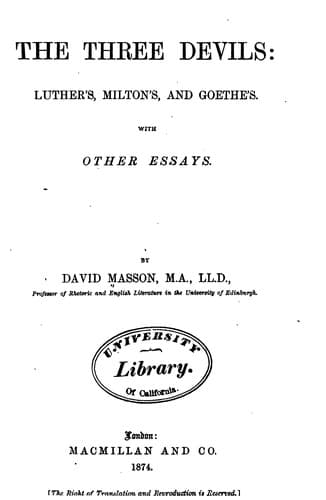
The Three Devils: Luther's, Milton's, and Goethe's; With Other EssaysMasson, David
History
The Three Devils: Luther's, Milton's, and Goethe's; With Other Essays
Masson, David
Devil in literature; Literature -- History and criticism
History itself, the mere tradition and records of the human race, would
have authorized our assertion. Pericles, Epaminondas, Alexander the Great,
Hannibal, Julius Cæsar, Charlemagne: would not the authenticated tradition
of the lives and actions of those men, and others of their order, or of
other orders, prove that possible capacity of the individual mind has not,
for the last 2,500 years of our earth's history, been a mere affair of
chronological date? But it is Literature that reads us the lesson most
fully and convincingly. Some of those great men of action have left little
or no direct speech of themselves. They mingled their minds with the rage
of things around them; they worked, and strove, and died. But the books we
have from all periods, the poems, the songs, the treatises, the
pleadings--some of them from men great also in the world of action, but
most from men who only looked on, and thought, and tried to rule the
spirit, or to find how it might be ruled--these remain with us and can be
studied yet microscopically. If what the Historian wants to get at is the
mind of the time that interests him, or of the past generally, here it is
for him in no disguised form, but in actual specimens. Poems, treatises,
and the like, are actual transmitted _bits_ of the mind of the past;
every fragment of verse or prose from a former period preserves something
of the thought and sentiment of that period expressed by some one
belonging to it; the masterpieces of the world's literature are the
thought and feeling of successive generations expressed, in and for each
generation, by those who could express them best. What a purblind
perversity then it is for History, professing that its aim is to know the
mind or real life of the past, to be fumbling for that mind or life amid
old daggers, rusty iron caps and jingling jackets, and other such material
relics as the past has transmitted, or even groping for it, as ought to be
done most strictly, in statutes and charters and records, if all the while
those literary remains of the past are neglected from which the very thing
searched for stares us face to face!
* * * * *
There is a small corollary to our main proposition. It is that ages which
we are accustomed to regard as crude, barbarous, and uncivilized, may turn
out perhaps, on due investigation and a better construction of the
records, to have been not so crude and barbarous after all, but to have
contained a great deal of intrinsic humanity, interesting to us yet, and
capable, through all intervening time and difference, of folding itself
round our hearts. And here I will quit those great, but perhaps too
continually obtrusive, Greeks and Romans, and will take my examples, all
the homelier though they must be, from our own land and kindred.
Public-domain text, read in full here on John Shaqi.
Reviews
Reviews
No reviews yet
Be the first to share your thoughts on this work.
Elsewhere in the archive
Join the Discussion
Join the discussion
Sign in to leave a comment or review.
Sign InorCreate an account