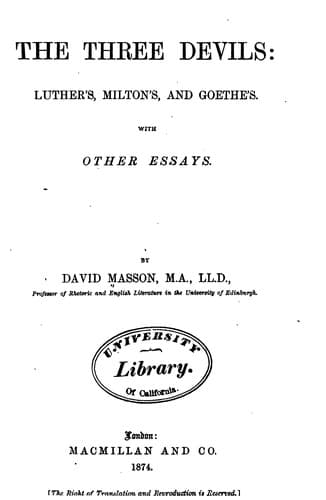
The Three Devils: Luther's, Milton's, and Goethe's; With Other EssaysMasson, David
History
The Three Devils: Luther's, Milton's, and Goethe's; With Other Essays
Masson, David
Devil in literature; Literature -- History and criticism
That thee is sent receive in buxomness;
The wrestling of this world asketh a fall;
Here is no home, here is but wilderness:
Forth, pilgrim! forth, beast, out of thy stall!
Look up on high, and thankè God of all:
Waivè thy lusts, and let thy ghost thee lead;
And truth shall thee deliver, it is no drede.
Or, finally, take a little bit of Chaucer's deep, keen slyness, when he is
speaking smilingly about himself and his own poetry. He has represented
himself as standing in the House or Temple of Fame, observing company
after company going up to the goddess, and petitioning for renown in the
world for what they have done. Some she grants what they ask, others she
dismisses crestfallen, and Chaucer thinks the _levée_ over:--
With that I gan about to wend,
For one that stood right at my back
Methought full goodly to me spak,
And said, "Friend, what is thy name?
Art _thou_ come hither to have fame?"
"Nay, forsoothè, friend," quoth I;
"I came not hither, grammercy,
For no such causè, by my head.
Sufficeth me, as I were dead,
That no wight have _my_ name in hand:
I wot myself best how I stand;
For what I dree or what I think
I will myselfè all it drink,
Certain for the morè part,
As farforth as I ken mine art!"
Chaucer ranks to this day as one of the very greatest and finest minds in
the entire literature of the English speech, and stands therefore on a
level far higher than can be assumed for his contemporary Barbour. But
Barbour was a most creditable old worthy too. Let us have a scrap or two
from his _Bruce_. Who does not know the famous passage which is the very
key-note of that poem? One is never tired of quoting it:--
Ah! freedom is a noble thing;
Freedom makes man to have liking:
Freedom all solace to man gives;
He lives at ease that freely lives.
A noble heart may have nane ease,
Ne ellys nought that may him please
Gif freedom faileth; for free liking
Is yearnit ower all other thing;
Nor he that aye has livit free
May not know weel the propertie,
The anger, ne the wretched doom,
That is couplit to foul thirldom;
But, gif he had essayit it,
Then all perquére he suld it wit,
And suld think freedom mair to prize
Than all the gold in the warld that is.
Or take the portrait of the good Sir James, called "The Black Douglas,"
the chief companion and adherent of Bruce, introduced near the beginning
of the poem, where he is described as a young man living moodily at St.
Andrews before the Bruce revolt:--
Public-domain text, read in full here on John Shaqi.
Reviews
Reviews
No reviews yet
Be the first to share your thoughts on this work.
Elsewhere in the archive
Join the Discussion
Join the discussion
Sign in to leave a comment or review.
Sign InorCreate an account