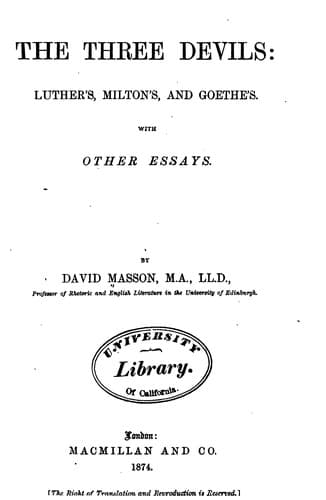
The Three Devils: Luther's, Milton's, and Goethe's; With Other EssaysMasson, David
History
The Three Devils: Luther's, Milton's, and Goethe's; With Other Essays
Masson, David
Devil in literature; Literature -- History and criticism
Ane weel great while there dwellit he:
All men loved him for his bountie;
For he was of full fair effere,
Wise, courteous, and debonair;
Large and lovand also was he,
And ower all thing loved loyauty.
Loyautie to love is gretumly;
Through loyautie men lives richtwisely;
With a virtue of loyautie
Ane man may yet sufficiand be;
And, but loyautie, may nane have prize,
Whether he be wicht or be he wise;
For, where _it_ failis, nae virtue
May be of prize, ne of value
To mak ane man sae good that he
May simply callit good man be.
He was in all his deedès leal;
For him dedeignit not to deal
With treachery ne with falsét.
His heart on high honóur was set,
And him contened in sic manére
That all him loved that war him near.
But he was not sae fair that we
Suld speak greatly of his beautíe.
In visage was he somedeal grey,
And had black hair, as I heard say;
But of his limbs he was well made,
With banès great and shoulders braid;
His body was well made leanlie,
As they that saw him said to me.
When he was blythe, he was lovely
And meek and sweet in company;
But wha in battle micht him see
All other countenance had he.
And in speech lispit he somedeal;
But that set him richt wonder weel.
To Good Hector of Troy micht he
In mony thingès likenit be.
Hector had black hair as he had,
And stark limbès and richt weel made,
And lispit also as did he,
And was fulfillit of loyautie,
And was courteous, and wise, and wicht.
Public-domain text, read in full here on John Shaqi.
Reviews
Reviews
No reviews yet
Be the first to share your thoughts on this work.
Elsewhere in the archive
Join the Discussion
Join the discussion
Sign in to leave a comment or review.
Sign InorCreate an account