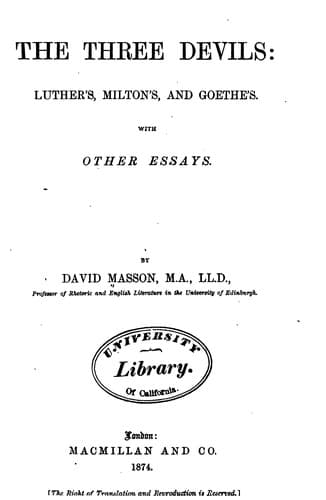
The Three Devils: Luther's, Milton's, and Goethe's; With Other EssaysMasson, David
History
The Three Devils: Luther's, Milton's, and Goethe's; With Other Essays
Masson, David
Devil in literature; Literature -- History and criticism
It would be possible farther to illustrate Luther's conception of the Evil
Principle by quoting many of his specific sayings about diabolic agency.
It would be found from these that his conception was that of a being to
whom evil of all kinds was dear. The Devil with him was a meteorological
agent. Devils, he said, are in woods, and waters, and dark poolly places,
ready to hurt passers-by; there are devils also in the thick black clouds,
who cause hail and thunders and lightnings, and poison the air and the
fields and the pastures. "When such things happen, philosophers say they
are natural, and ascribe them to the planets, and I know not what all."
The Devil he believed also to be the patron of witchcraft. The Devil, he
said, had the power of deceiving the senses, so that one should swear he
heard or saw something while really the whole was an illusion. The Devil
also was at the bottom of dreaming and somnambulism. He was likewise the
author of diseases. "I hold," said Luther, "that the Devil sendeth all
heavy diseases and sicknesses upon people." Diseases are, as it were, the
Devil striking people; only, in striking, he must use some natural
instrument, as a murderer uses a sword. When our sins get the upper hand,
and all is going wrong, then the Devil must be God's hangman, to clear
away obstructions and to blast the earth with famines and pestilences.
Whatsoever procures death, that is the Devil's trade. All sadness and
melancholy come of the Devil. So does insanity; but the Devil has no
farther power over the soul of a maniac. The Devil works in the affairs of
nations. He looks always upward, taking an interest in what is high and
pompous; he does not look downward, taking little interest in what is
insignificant and lowly. He likes to work on the great scale, to establish
an influence over the central minds which manage public affairs. The Devil
is also a spiritual tempter. He is the opponent of the Divine grace in the
hearts of individuals. This was the aspect of the doctrine of Satanic
agency which was most frequent in preaching; and, accordingly, Luther's
propositions on the point are very specific. He had ascertained the laws
of Satanic operation upon the human spirit. The Devil, he said, knows
Scripture well, and uses it in argument. He shoots fearful thoughts, which
are his fiery darts, into the hearts of the godly. The Devil is acquainted
even with those mysterious enjoyments, those spiritual excitements, which
the Christian would suppose a being like him must be ignorant of. "What
gross inexperienced fellows," Luther says, "are those Papist commentators!
They are for interpreting Paul's 'thorn in the flesh' to be merely fleshly
lust; because they know no other kind of tribulation than that." But,
though the Devil has great power over the human mind, he is limited in
some respects. He has no means, for instance, of knowing the thoughts of
the faithful until they give them utterance. Again, if the Devil be once
Public-domain text, read in full here on John Shaqi.
Reviews
Reviews
No reviews yet
Be the first to share your thoughts on this work.
Join the Discussion
Join the discussion
Sign in to leave a comment or review.
Sign InorCreate an account