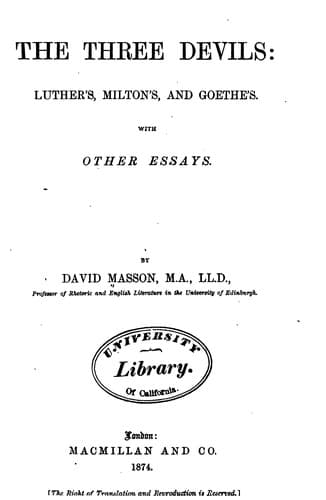
The Three Devils: Luther's, Milton's, and Goethe's; With Other EssaysMasson, David
History
The Three Devils: Luther's, Milton's, and Goethe's; With Other Essays
Masson, David
Devil in literature; Literature -- History and criticism
There are, indeed, many and various gods in our modern Pantheon of genius.
It contains rough gods and smooth gods, gods of symmetry and gods of
strength, gods great and terrible, gods middling and respectable, and
little cupids and toy-gods. Out of this variety each master of a household
will select his own Penates, the appropriate gods of his own mantelpiece.
The roughest will find some to worship them, and the smallest shall not
want domestic adoration. But we suppose a dilettante of the first class,
one who, besides excluding from his range of choice the deities of war,
and cold thought, and civic action, shall further exclude from it all
those even of the gods of modern literature who, whether by reason of
their inferior rank, or by reason of their peculiar attributes, fail as
models of universal stateliness. What we should expect to see over the
mantelpiece of such a rigorous person would be the images of the English
Shakespeare and the German Goethe.
On the one side, we will suppose, fixed with due gance against the
luxurious crimson of the wall, would be a slab of black marble exhibiting
in relief a white plaster-cast of the face of Shakespeare as modelled from
the Stratford bust; on the other, in a similar setting, would be a copy,
if possible, of the mask of Goethe taken at Weimar after the poet's death.
This would suffice; and the considerate beholder could find no fault with
such an arrangement. It is true, reasons might be assigned why a third
mask should have been added--that of the Italian Dante; in which case
Dante and Goethe should have occupied the sides, and Shakespeare should
have been placed higher up between. But the master of the house would
point out how, in that case, a fine taste would have been pained by the
inevitable sense of contrast between the genial mildness of the two
Teutonic faces and the severe and scornful melancholy of the poet of the
Inferno. The face of the Italian poet, as being so different in kind, must
either be reluctantly omitted, he would say, or transferred by itself to
the other side of the room. Unless, indeed, with a view to satisfy the
claims both of degree and of kind, Shakespeare were to be placed alone
over the mantelpiece, and Dante and Goethe in company on the opposite
wall, where, there being but two, the contrast would be rather agreeable
than otherwise! On the whole, however, and without prejudice to new
arrangements in the course of future decorations, he is content that it
should be as it is.
And so, reader, for the present are we. Let us enter together, then, if it
seems worth while, the room of this imaginary dilettante during his
absence; let us turn the key in the lock, so that he may not come in to
interrupt us; and let us look for a little time at the two masks he has
provided for us over the mantelpiece, receiving such reflections as they
may suggest. Doubtless we have often looked at the two masks before; but
that matters little.
* * * * *
Public-domain text, read in full here on John Shaqi.
Reviews
Reviews
No reviews yet
Be the first to share your thoughts on this work.
Join the Discussion
Join the discussion
Sign in to leave a comment or review.
Sign InorCreate an account