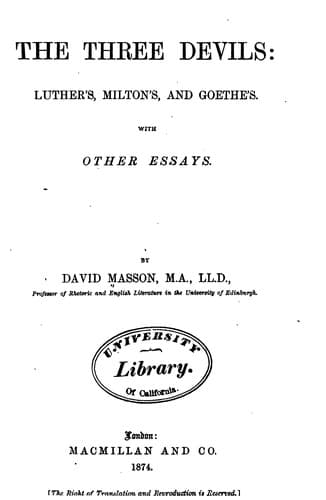
The Three Devils: Luther's, Milton's, and Goethe's; With Other EssaysMasson, David
History
The Three Devils: Luther's, Milton's, and Goethe's; With Other Essays
Masson, David
Devil in literature; Literature -- History and criticism
These are but one or two out of many such passages occurring in the
Sonnets. Indeed, it may be said that, whenever Shakespeare pronounces the
words time, age, death, and the like, it is with a deep and cutting
personal emphasis, quite different from the usual manner of poets in their
stereotyped allusions to mortality. Time, in particular, seems to have
tenanted his imagination as a kind of grim and hideous personal existence,
cruel out of mere malevolence of nature. Death, too, had become to him a
kind of actual being or fury, morally unamiable, and deserving of
reproach: "that churl Death."
If we turn to the plays of Shakespeare, we shall find that in them too the
same morbid sensitiveness to all associations with mortality is
continually breaking out. The vividness, for example, with which Juliet
describes the interior of a charnel-house partakes of a spirit of revenge,
as if Shakespeare were retaliating, through her, upon an object horrible
to himself:--
"Or hide me nightly in a charnel-house,
O'ercovered quite with dead men's rattling bones,
With reeky shanks and yellow chapless skulls."
More distinctly revengeful is Romeo's ejaculation at the tomb:--
"Thou détestable maw, thou womb of Death,
Gorged with the dearest morsel of the earth,
Thus I enforce thy rotten jaws to open!"
And who does not remember the famous passage in _Measure for Measure_?--
"_Claudio._ Death is a fearful thing.
_Isabella._ And shamed life is hateful.
_Claudio._ Ay, but to die, and go we know not where;
To lie in cold obstruction and to rot;
This sensible warm motion to become
A kneaded clod; and the delighted spirit
To bathe in fiery floods, or to reside
In thrilling regions of thick-ribbèd ice;
To be imprisoned in the viewless winds,
And blown with restless violence round about
The pendent world; or to be worse than worst
Of those that lawless and incertain thoughts
Imagine howling: 'tis too horrible!
The weariest and most loathed worldly life
That age, ache, penury, and imprisonment,
Can lay on nature is a paradise
To what we fear of Death."
Again in the grave-digging scene in _Hamlet_ we see the same fascinated
familiarity of the imagination with all that pertains to churchyards,
coffins, and the corruption within them.
"_Hamlet._ Prithee, Horatio, tell me one thing.
_Horatio._ What's that, my lord?
_Hamlet._ Dost thou think Alexander looked o' this fashion i' the
earth?
_Horatio._ E'en so.
_Hamlet._ And smelt so? pah! (_Puts down the skull._)
_Horatio._ E'en so, my lord!
_Hamlet._ To what base uses we may return, Horatio! Why may not
imagination trace the noble dust of Alexander till he find it
stopping a bung-hole?
Public-domain text, read in full here on John Shaqi.
Reviews
Reviews
No reviews yet
Be the first to share your thoughts on this work.
Join the Discussion
Join the discussion
Sign in to leave a comment or review.
Sign InorCreate an account