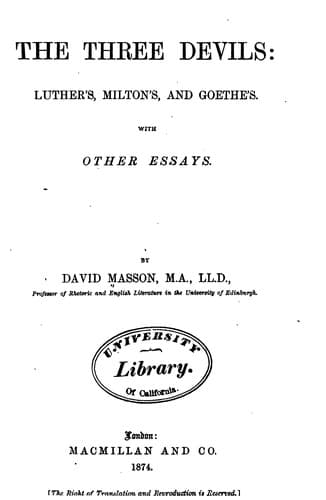
The Three Devils: Luther's, Milton's, and Goethe's; With Other EssaysMasson, David
History
The Three Devils: Luther's, Milton's, and Goethe's; With Other Essays
Masson, David
Devil in literature; Literature -- History and criticism
_Horatio._ 'Twere to reason too curiously to consider so.
_Hamlet._ No, faith, not a jot; but to follow him thither with
modesty enough, and likelihood to lead it: as thus:--Alexander died;
Alexander was buried; Alexander returneth to dust; the dust is earth;
of earth we make loam; and why of that loam whereto he was converted
might they not stop a beer-barrel?
Imperial Cæsar, dead and turned to clay,
Might stop a hole to keep the wind away:
O that that earth which kept the world in awe
Should patch a wall to expel the winter's flaw!"
Observe how Shakespeare here defends, through Hamlet, his own tendency
"too curiously" to consider death. To sum up all, however, let us turn to
that unparalleled burst of language in the _Tempest_, in which the poet
has defeated Time itself by chivalrously proclaiming to all time what Time
can do:--
"And, like the baseless fabric of this vision,
The cloud-capped towers, the gorgeous palaces,
The solemn temples, the great globe itself,
Yea, all which it inherit, shall dissolve,
And, like this unsubstantial pageant faded,
Leave not a rack behind. We are such stuff
As dreams are made of; and our little life
Is rounded with a sleep."
This, we contend, is no mere poetic phrenzy, inserted because it was
dramatically suitable that Prospero should so express himself at that
place; it is the explosion into words of a feeling during which Prospero
was forgotten, and Shakespeare swooned into himself. And what is the
continuation of the passage but a kind of postscript, describing, under
the guise of Prospero, Shakespeare's own agitation with what he had just
written?--
"Sir, I am vexed;
Bear with my weakness; my old brain is troubled:
Be not disturbed with my infirmity:
If you be pleased, retire into my cell,
And there repose: _a turn or two I'll walk,
To still my beating mind_."
To our imagination the surmise is that Shakespeare here laid down his pen,
and began to pace his chamber, too agitated to write more that night.
Public-domain text, read in full here on John Shaqi.
Reviews
Reviews
No reviews yet
Be the first to share your thoughts on this work.
Join the Discussion
Join the discussion
Sign in to leave a comment or review.
Sign InorCreate an account