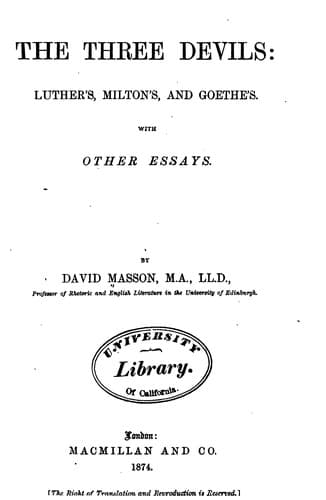
The Three Devils: Luther's, Milton's, and Goethe's; With Other EssaysMasson, David
History
The Three Devils: Luther's, Milton's, and Goethe's; With Other Essays
Masson, David
Devil in literature; Literature -- History and criticism
This brings us, by a very natural connexion, to what we have to say of
Goethe. For, if, with the foregoing impressions on our mind respecting the
character and the function of the great English poet, we turn to the mask
of his German successor and admirer, which has been so long waiting our
notice, the first question must infallibly be What recognition is it
possible that, in such circumstances, we can have left for _him_? In other
words, the first consideration that must be taken into account in any
attempt to appreciate Goethe is that he came into a world in which
Shakespeare had been before him. For a man who, in the main, was to pursue
a course so similar to that which Shakespeare had pursued this was a
matter of incalculable importance. Either, on the one hand, the value of
all that the second man could do, if he adhered to a course very similar,
must suffer from the fact that he was following in the footsteps of a
predecessor of such unapproachable excellence; or, on the other hand, the
consciousness of this, if it came in time, would be likely to _prevent_
too close a resemblance between the lives of the two men, by giving a
special direction and character to the efforts of the second. Hear Goethe
himself on this very point:--
"We discoursed upon English literature, on the greatness of
Shakespeare, and on the unfavourable position held by all English
dramatic authors who had appeared after that poetical giant. 'A
dramatic talent of any importance,' said Goethe, 'could not forbear
to notice Shakespeare's works; nay, could not forbear to study them.
Having studied them, he must be aware that Shakespeare has already
exhausted the whole of human nature in all its tendencies, in all its
heights and depths, and that, in fact, there remains for him, the
aftercomer, nothing more to do. And how could one get courage to put
pen to paper, if one were conscious, in an earnest appreciating
spirit, that such unfathomable and unattainable excellencies were
already in existence? It fared better with me fifty years ago in my
own dear Germany. I could soon come to an end with all that then
existed; it could not long awe me, or occupy my attention. I soon
left behind me German literature, and the study of it, and turned my
thoughts to life and to production. So on and on I went, in my own
natural development, and on and on I fashioned the productions of
epoch after epoch. And, at every step of life and development, my
standard of excellence was not much higher than what at such a step
I was able to attain. But, had I been born an Englishman, and had all
those numerous masterpieces been brought before me in all their power
at my first dawn of youthful consciousness, they would have
overpowered me, and I should not have known what to do. I could not
have gone on with such fresh light-heartedness, but should have had
Public-domain text, read in full here on John Shaqi.
Reviews
Reviews
No reviews yet
Be the first to share your thoughts on this work.
Elsewhere in the archive
Join the Discussion
Join the discussion
Sign in to leave a comment or review.
Sign InorCreate an account