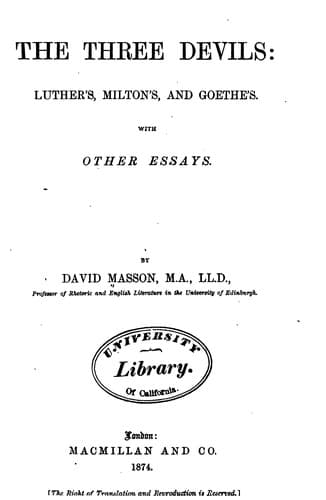
The Three Devils: Luther's, Milton's, and Goethe's; With Other EssaysMasson, David
History
The Three Devils: Luther's, Milton's, and Goethe's; With Other Essays
Masson, David
Devil in literature; Literature -- History and criticism
to bethink myself, and look about for a long time to find some new
outlet.'"--_Eckermann's Conversations of Goethe_, i. pp. 114, 115.
All this is very clear and happily expressed. Most Englishmen that have
written since Shakespeare _have_ been overawed by the sense of his vast
superiority; and Goethe, if he had been an Englishman, would have partaken
of the same feeling, and would have been obliged, as he says, to look
about for some path in which competition with such a predecessor would
have been avoided. Being, however, a German, and coming at a time when
German literature had nothing so great to boast of but that an ardent
young man could hope to produce something as good or better, the way was
certainly open to him to the attainment, in his own nation, of a position
analogous to that which Shakespeare had occupied in his. Goethe might, if
he had chosen, have aspired to be the Shakespeare of Germany. Had his
tastes and faculties pointed in that direction, there was no reason,
special to his own nation, that would have made it very incumbent on him
to thwart the tendency of his genius and seek about for a new outlet in
order to escape injurious comparisons. But, even in such circumstances, to
have pursued a course _very_ similar to that of Shakespeare, and to have
been animated by a mere ambition to tread in the footsteps of that master,
would have been death to all chance of a reputation among the highest.
Great writers do not exclusively belong to the country of their birth; the
greatest of all are grouped together on a kind of central platform, in the
view of all peoples and tongues; and, as in this select assemblage no
duplicates are permitted, the man who does never so well a second time
that which the world has already canonized a man for doing once has little
chance of being admitted to co-equal honours. More especially in the
present case would too close a resemblance to the original, whether in
manner or in purpose, have been regarded in the end as a reason for
inferiority in place. As the poet of one branch of the great Germanic
family of mankind, Shakespeare belonged indirectly to the Germans, even
before they recognised him; in him all the genuine qualities of Teutonic
human nature, as well as the more special characteristics of English
genius, were embodied once for all in the particular form which had
chanced to be his; and, had Goethe been, in any marked sense, only a
repetition of the same form, he might have held his place for some time as
the wonder of Germany, but, as soon as the course of events had opened up
the communication which was sure to take place at some time between the
German and the English literatures, and so made his countrymen acquainted
with Shakespeare, he would have lost his extreme brilliance, and become
but a star of the second magnitude. In order, then, that Goethe might hold
permanently a first rank even among his own countrymen, it was necessary
Public-domain text, read in full here on John Shaqi.
Reviews
Reviews
No reviews yet
Be the first to share your thoughts on this work.
Elsewhere in the archive
Join the Discussion
Join the discussion
Sign in to leave a comment or review.
Sign InorCreate an account