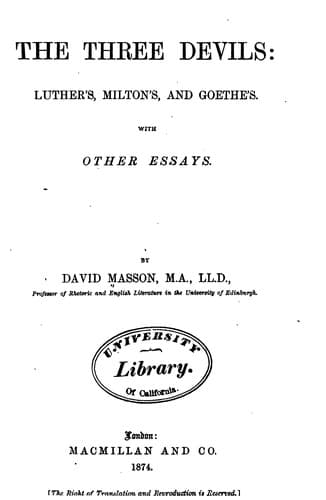
The Three Devils: Luther's, Milton's, and Goethe's; With Other EssaysMasson, David
History
The Three Devils: Luther's, Milton's, and Goethe's; With Other Essays
Masson, David
Devil in literature; Literature -- History and criticism
that he should be a man of a genius quite distinct from that of
Shakespeare, a man who, having or not having certain Shakespearian
qualities, should at all events signalize such qualities as he had by a
marked character and function of his own. And, if this was necessary to
secure to Goethe a first rank in the literature of Germany, much more was
it necessary to ensure him a place as one of the intellectual potentates
of the whole modern world. If Goethe was to be admitted into this select
company at all, it could not be as a mere younger brother of Shakespeare,
but as a man whom Shakespeare himself, when he took him by the hand, would
look at with curiosity, as something new in species, produced in the earth
since his own time.
Was this, then, the case? Was Goethe, with all his external resemblance in
some respects to Shakespeare, a man of such truly individual character,
and of so new and marked a function, as to deserve a place among the
highest, not in German literature alone, but in the literature of the
world as a whole? We do not think that anyone competent to give an opinion
will reply in the negative.
A glance at the external circumstances of Goethe's life alone (and what a
contrast there is between the abundance of biographic material respecting
Goethe and the scantiness of our information respecting Shakespeare!) will
beget the impression that the man who led such a life must have had
opportunities for developing a very unusual character. The main facts in
the life of Goethe are:--that he was born at Frankfort-on-the-Main in
1749, the only surviving son of parents who ranked among the wealthiest in
the town; that, having been educated with extreme care, and having
received whatever experience could be acquired by an impetuous
student-life, free from all ordinary forms of hardship, first at one
German town and then at another, he devoted himself, in accordance with
his tastes, to a career of literary activity; that, after unwinding
himself from several love-affairs, and travelling for the sake of farther
culture in Italy and other parts of Europe, he settled in early manhood at
Weimar, as the intimate friend and counsellor of the reigning duke of that
state; that there, during a long and honoured life, in the course of which
he married an inferior housekeeper kind of person, of whom we do not hear
much, he prosecuted his literary enterprise with unwearied industry, not
only producing poems, novels, dramas, essays, treatises, and criticisms in
great profusion from his own pen, but also acting, along with Schiller and
others, as a director and guide of the whole contemporary intellectual
movement of his native land; and that finally, having outlived all his
famous associates, become a widower and a grandfather, and attained the
position not only of the acknowledged king and patriarch of German
literature, but also, as some thought, of the wisest and most serene
intellect of Europe, he died so late as 1832, in the eighty-third year of
Public-domain text, read in full here on John Shaqi.
Reviews
Reviews
No reviews yet
Be the first to share your thoughts on this work.
Elsewhere in the archive
Join the Discussion
Join the discussion
Sign in to leave a comment or review.
Sign InorCreate an account