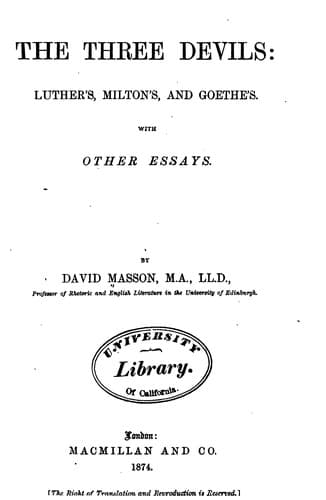
The Three Devils: Luther's, Milton's, and Goethe's; With Other EssaysMasson, David
History
The Three Devils: Luther's, Milton's, and Goethe's; With Other Essays
Masson, David
Devil in literature; Literature -- History and criticism
his age. All this, it will be observed, is very different from the life of
the prosperous Warwickshire player, whose existence had illustrated the
early part of the seventeenth century in England; and it necessarily
denoted, at the same time, a very different cast of mind and temper.
Accordingly, such descriptions as we have of Goethe from those who knew
him best convey the idea of a character notably different from that of the
English poet. Of Shakespeare personally we have but one uniform
account--that he was a man of gentle presence and disposition, very good
company, and of such boundless fluency and intellectual inventiveness in
talk that his hearers could not always stand it, but had sometimes to
whistle him down in his flights. In Goethe's case we have two distinct
pictures.
In youth, as all accounts agree in stating, he was one of the most
impetuous, bounding, ennui-dispelling natures that ever broke in upon a
society of ordinary mortals assembled to kill time. "He came upon you,"
said one who knew him well at this period, "like a wolf in the night." The
simile is a splendid one, and it agrees wonderfully with the more subdued
representations of his early years given by Goethe himself in his
Autobiography. Handsome as an Apollo and welcome everywhere, he bore all
before him wherever he went, not only by his talent, but also by an
exuberance of animal spirits which swept dulness itself along, took away
the breath of those who relied on sarcasm and their cool heads, inspired
life and animation into the whole circle, and most especially delighted
the ladies. This vivacity became even, at times, a reckless humour,
prolific in all kinds of mad freaks and extravagances. Whether this
impetuosity kept always within the bounds of mere innocent frolic is a
question which we need not here raise. Traditions are certainly afloat of
terrible domestic incidents connected with Goethe's youth, both in
Frankfort and in Weimar; but to what extent those traditions are founded
on fact is a matter which we have never yet seen any attempt to decide
upon evidence. More authentic for us, and equally significant, if we could
be sure of our ability to appreciate them rightly, are the stories which
Goethe himself tells of his various youthful attachments, and the various
ways in which they were concluded. In Goethe's own narratives of these
affairs there is a confession of error, arising out of his disposition
passionately to abandon himself to the feelings of the moment without
looking forward to the consequences; but whether this confession is to be
converted by his critics into the harsher accusation of heartlessness and
want of principle is a thing not to be decided by any general rule as to
the matter of inconstancy, but by accurate knowledge in each case of the
whole circumstances of that case. One thing these love-romances of
Goethe's early life make clear--that, for a being of such extreme
Public-domain text, read in full here on John Shaqi.
Reviews
Reviews
No reviews yet
Be the first to share your thoughts on this work.
Elsewhere in the archive
Join the Discussion
Join the discussion
Sign in to leave a comment or review.
Sign InorCreate an account