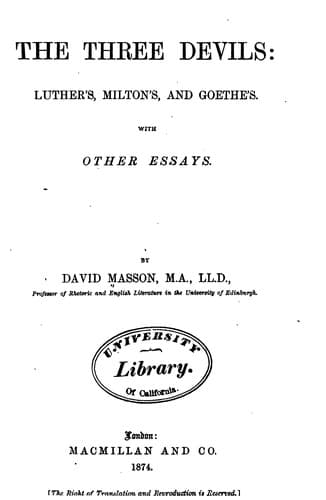
The Three Devils: Luther's, Milton's, and Goethe's; With Other EssaysMasson, David
History
The Three Devils: Luther's, Milton's, and Goethe's; With Other Essays
Masson, David
Devil in literature; Literature -- History and criticism
sensibility as he was, he had a very strong element of self-control. When
he gave up Rica or Lilli, it was with tears, and no end of sleepless
nights; and yet he gave them up. Shakespeare, we believe (and there is an
instance exactly in point in the story of his Sonnets), had no such power
of breaking clear from connexions which his judgment disapproved. Remorse
and return, self-reproaches for his weakness at one moment followed the
next by weakness more abject than before--such, by his own confession, was
the conduct, in one such case, of our more passive and gentle-hearted
poet. Where Shakespeare was "past cure," and "frantic-mad with evermore
unrest," Goethe but fell into "hypochondria," which reason and resolution
enabled him to overcome. Goethe at twenty-five gave up a young, beautiful
and innocent girl, from the conviction that it was better to do so.
Shakespeare at thirty-five was the abject slave of a dark-complexioned
woman, who was faithless to him, and whom he cursed in his heart. The
sensibilities in the German poet moved from the first, as we have already
said, over a firmer basis of permanent character.
It is chiefly, however, the Goethe of later life that the world remembers
and thinks of. The bounding impetuosity is then gone; or rather it is kept
back and restrained, so as to form a calm and steady fund of internal
energy, capable sometimes of a flash and outbreak, but generally revealing
itself only in labour and its fruits. What was formerly the beauty of an
Apollo, graceful, light, and full of motion, is now the beauty of a
Jupiter, composed, stately, serene. "What a sublime form!" says Eckermann,
describing his first interview with him. "I forgot to speak for looking at
him: I could not look enough. His face is so powerful and brown, full of
wrinkles, and each wrinkle full of expression. And everywhere there is
such nobleness and firmness, such repose and greatness. He spoke in a
slow, composed manner, such as you would expect from an aged monarch."
Such is Goethe, as he lasts now in the imagination of the world. Living
among statues, books, and pictures; daily doing something for his own
culture and for that of the world; daily receiving guests and visitors,
whom he entertained and instructed with his wise and deep, yet charming
and simple, converse; daily corresponding with friends and strangers, and
giving advice or doing a good turn to some young talent or other--never
was such a mind consecrated so perseveringly and exclusively to the
service of _Kunst_ and _Literatur_. One almost begins to wonder if it was
altogether right that an old man should go on, morning after morning, and
evening after evening, in such a fashion, talking about art and science
and literature as if they were the only interests in the world, taking his
guests into corners to have quiet discussions with them on these subjects,
and always finding something new and nice to be said about them. Possibly,
Public-domain text, read in full here on John Shaqi.
Reviews
Reviews
No reviews yet
Be the first to share your thoughts on this work.
Elsewhere in the archive
Join the Discussion
Join the discussion
Sign in to leave a comment or review.
Sign InorCreate an account