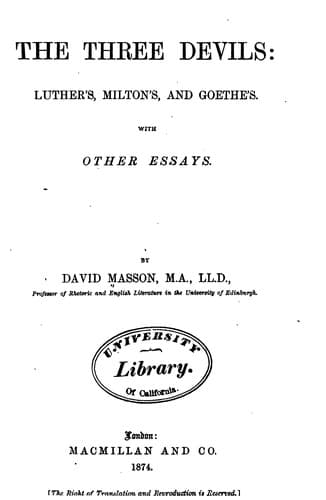
The Three Devils: Luther's, Milton's, and Goethe's; With Other EssaysMasson, David
History
The Three Devils: Luther's, Milton's, and Goethe's; With Other Essays
Masson, David
Devil in literature; Literature -- History and criticism
indeed, this is the fault of those who have reported him, and who only
took notes when the discourse turned on what they considered the proper
Goethean themes. But that Goethe far outdid Shakespeare in this conscious
dedication of himself to a life of the intellect is as certain as the
testimony of likelihood can make it. Shakespeare did enjoy his art; it was
what, in his pensive hours, as he himself hints, he enjoyed most; and
whatever of intellectual ecstasy literary production can bring must surely
have been his in those hours when he composed _Hamlet_ and the _Tempest_.
But Shakespeare's was precisely one of those minds whose strength is a
revelation to themselves during the moment of its exercise, rather than a
chronic ascertained possession; and from this circumstance, as well as
from the attested fact of his carelessness as to the fate of his
compositions, we can very well conceive that literature and mental culture
formed but a small part of the general system of things in Shakespeare's
daily thoughts, and that he would have been absolutely ashamed of himself
if, when anything else, from the state of the weather to the quality of
the wine, was within the circle of possible allusion, he had said a word
about his own plays. If he had not Sir Walter Scott's positive conviction
that every man ought to be either a laird or a lawyer, casting in
authorship as a mere addition if it were to be practised at all, he at
least led so full and keen a life, and was drawn forth on so many sides by
nature, society, and the unseen, that Literature, out of the actual
moments in which he was engaged in it, must have seemed to him a mere
bagatelle, a mere fantastic echo of not a tithe of life. In his home in
London, or his retirement at Stratford, he wrote on and on, because he
could not help doing so, and because it was his business and his solace;
but no play seemed to him worth a day of the contemporary actions of men,
no description worth a single glance at the Thames or at the deer feeding
in the forest, no sonnet worth the tear it was made to embalm. Literature
was by no means to him, as it was to Goethe, the main interest of life;
nor was he a man so far master of himself as ever to be able to behave as
if it were so, and to accept, as Goethe did, all that occurred as so much
culture. Yet Shakespeare would have understood Goethe, and would have
regarded him, almost with envy, as one of those men who, as being "lords
and owners of their faces," and not mere "stewards," know how to husband
Nature's gifts best.
"They that have power to hurt and will do none,
That do not do the thing they most do show,
Who, moving others, are themselves as stone,
Unmovèd, cold, and to temptation slow,
They rightly do inherit Heaven's graces,
And husband nature's riches from expense;
They are the lords and owners of their faces,
Others but stewards of their excellence."--_Sonnet 94._
Public-domain text, read in full here on John Shaqi.
Reviews
Reviews
No reviews yet
Be the first to share your thoughts on this work.
Elsewhere in the archive
Join the Discussion
Join the discussion
Sign in to leave a comment or review.
Sign InorCreate an account