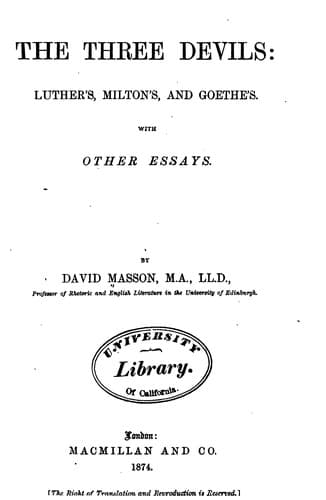
The Three Devils: Luther's, Milton's, and Goethe's; With Other EssaysMasson, David
History
The Three Devils: Luther's, Milton's, and Goethe's; With Other Essays
Masson, David
Devil in literature; Literature -- History and criticism
_The Abstract and the Concrete, and the Subjective and the
Objective._--"The Germans are certainly strange people. By their deep
thoughts and ideas, which they seek in everything, and fix upon
everything, they make life much more burdensome than is necessary.
Only have the courage to give yourself up to your impressions; allow
yourself to be delighted, moved, elevated--nay, instructed and
inspired by something great; but do not imagine all is vanity if it
is not abstract thought and idea.... It was not in my line, as a
poet, to strive to embody anything abstract. I received in my mind
impressions, and those of a sensual, animated, charming, varied,
hundred-fold kind, just as a lively imagination presented them; and I
had, as a poet, nothing more to do than artistically to round off and
elaborate such views and impressions, and by means of a lively
representation so to bring them forward that others might receive the
same impressions in hearing or reading my representation of them....
A poet deserves not the name while he only speaks out his few
subjective feelings; but as soon as he can appropriate to himself and
express the world he is a poet. Then he is inexhaustible, and can be
always new; while a subjective nature has soon talked out his little
internal material, and is at last ruined by mannerism. People always
talk of the study of the ancients; but what does that mean, except
that it says 'Turn your attention to the real world, and try to
express it, for that is what the ancients did when they were alive?'
Goethe arose and walked to and fro, while I remained seated at the
table, as he likes to see me. He stood a moment at the stove, and
then, like one who has reflected, came to me, and, with his finger on
his lips, said to me, 'I will now tell you something which you will
often find confirmed in your own experience. All eras in a state of
decline and dissolution are subjective; on the other hand, all
progressive eras have an objective tendency. Our present time is
retrograde, for it is subjective; we see this not merely in poetry,
but also in painting and much besides. Every healthy effort, on the
contrary, is directed from the inward to the outward world, as you
will see in all great eras, which have been really in a state of
progression, and all of an objective nature.'"--_Ibid._ vol. i. pp.
415, 416, and pp. 283, 284.
Public-domain text, read in full here on John Shaqi.
Reviews
Reviews
No reviews yet
Be the first to share your thoughts on this work.
Elsewhere in the archive
Join the Discussion
Join the discussion
Sign in to leave a comment or review.
Sign InorCreate an account