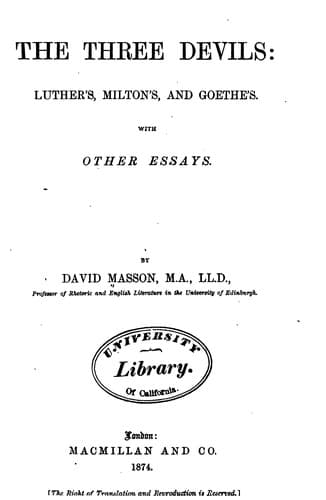
The Three Devils: Luther's, Milton's, and Goethe's; With Other EssaysMasson, David
History
The Three Devils: Luther's, Milton's, and Goethe's; With Other Essays
Masson, David
Devil in literature; Literature -- History and criticism
_Goethe's Doctrine of Immortality._--"Kant has unquestionably done
the best service, by drawing the limits beyond which human intellect
is not able to penetrate, and leaving at rest the insoluble problems.
What a deal have people philosophised about immortality! and how far
have they got? I doubt not of our immortality, for nature cannot
dispense with the _entelecheia_. But we are not all, in like manner,
immortal; and he who would manifest himself in future as a great
_entelecheia_ must be one now.... To me the eternal existence of my
soul is proved from my idea of activity. If I work on incessantly
till my death, nature is bound to give me another form of existence
when the present one can no longer sustain my spirit."--_Ibid._ vol.
ii. pp. 193, 194, and p. 122.
_Goethe's Image of Life._--"Child, child, no more! The coursers of
Time, lashed, as it were, by invisible spirits, hurry on the light
car of our destiny; and all that we can do is, in cool
self-possession, to hold the reins with a firm hand, and to guide the
wheels, now to the left, now to the right, avoiding a stone here, or
a precipice there. Whither it is hurrying, who can tell? and who,
indeed, can remember the point from which it started?"--_Egmont._
_Man's proper business._--"It has at all times been said and repeated
that man should strive to know himself. This is a singular
requisition; with which no one complies, or indeed ever will comply.
Man is by all his senses and efforts directed to externals--to the
world around him; and he has to know this so far, and to make it so
far serviceable, as he requires for his own ends. It is only when he
feels joy or sorrow that he knows anything about himself, and only by
joy or sorrow is he instructed what to seek and what to
shun."--_Eckermann's Conversations of Goethe_, vol. ii. p. 180.
Public-domain text, read in full here on John Shaqi.
Reviews
Reviews
No reviews yet
Be the first to share your thoughts on this work.
Elsewhere in the archive
Join the Discussion
Join the discussion
Sign in to leave a comment or review.
Sign InorCreate an account