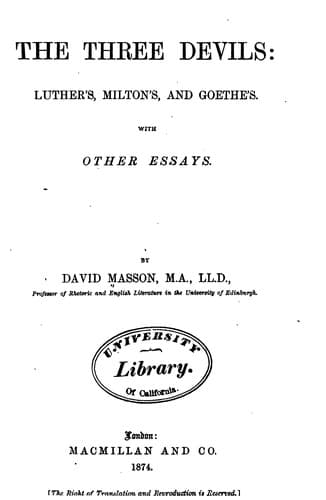
The Three Devils: Luther's, Milton's, and Goethe's; With Other EssaysMasson, David
History
The Three Devils: Luther's, Milton's, and Goethe's; With Other Essays
Masson, David
Devil in literature; Literature -- History and criticism
is the good, noble, and beautiful: which is confined to no particular
province or country, and which he seizes upon and forms wherever he
finds them. Therein he is like the eagle, who hovers with free gaze
over whole countries, and to whom it is of no consequence whether the
hare on which he pounces is running in Prussia or in
Saxony.'"--_Ibid._ vol. ii. pp. 257, 258, and p. 427.
Whoever has read these sentences attentively, and penetrated their meaning
in connexion, will see that they reveal a mode of thought somewhat
resembling that which we have attributed to Shakespeare, and yet
essentially different from it. Both poets are distinguished by this, that
they abstained systematically during their lives from the abstract, the
dialectical, and the controversial, and devoted themselves, with true
feeling and enjoyment, to the concrete, the real, and the unquestioned;
and so far there is an obvious resemblance between them. But the manner in
which this characteristic was attained was by no means the same in both
cases. In Shakespeare, as we have seen, there was a metaphysical longing,
a tendency towards the supersensible and invisible, absolutely morbid, if
we take ordinary constitutions as the standard of health in this respect;
and, if, with all this, he revelled with delight and moved with ease and
firmness in the sensuous and actual, it was because the very same soul
which pressed with such energy and wailing against the bounds of this life
of man was also related with inordinate keenness and intimacy to all that
this life spheres in. In Goethe, on the other hand, the tendency to the
real existed under easier constitutional conditions, and in a state of
such natural preponderance over any concomitant craving for the
metaphysical, that it necessarily took, German though he was, a higher
place in his estimate of what is desirable in a human character. That
world of the real in which Shakespeare delighted, and which he knew so
well, seemed to him, all this knowledge and delight notwithstanding, far
more evanescent, far more a mere filmy show, far less considerable a shred
of all that is, than it did to Goethe. To Shakespeare, as we have already
said, life was but as a little island on the bosom of a boundless sea: men
must needs know what the island contains, and act as those who have to
till and rule it; still, with that expanse of waters all round in view,
and that roar of waters ever in the ear, what can men call themselves or
pretend their realm to be? "Poor fools of Nature" is the poet's own
phrase--the realm so small that it is pitiful to belong to it! Not so with
Goethe. To him also, of course, the thought was familiar of a vast region
of the supersensible outlying nature and life; but a higher value on the
whole was reserved for nature and life, even on the universal scale, by
his peculiar habit of conceiving them, not as distinct from the
Public-domain text, read in full here on John Shaqi.
Reviews
Reviews
No reviews yet
Be the first to share your thoughts on this work.
Elsewhere in the archive
Join the Discussion
Join the discussion
Sign in to leave a comment or review.
Sign InorCreate an account