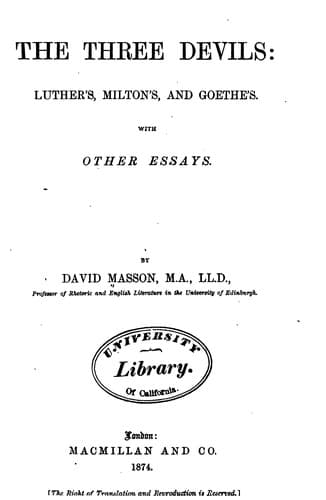
The Three Devils: Luther's, Milton's, and Goethe's; With Other EssaysMasson, David
History
The Three Devils: Luther's, Milton's, and Goethe's; With Other Essays
Masson, David
Devil in literature; Literature -- History and criticism
supersensible and contemporaneously begirt by it, but rather, if we may so
speak, as a considerable portion, or even duration, of the
_quondam_-supersensible in the new form of the sensible. In other words,
Goethe was full of the notion of progress or evolution; the world was to
him not a mere spectacle and dominion for the supernatural, but an actual
manifestation of the substance of the supernatural itself, on its way
through time to new issues. Hence his peculiar notion of immortality;
hence his view as to the mere relativeness of the terms right and wrong,
good and bad, and the like; and hence also his resolute inculcation of the
doctrine, so unpalatable to his countrymen, that men ought to direct their
thoughts and efforts to the actual and the outward. Life being the current
phase of the universal mystery, the true duty of men could be but to
contribute in their various ways to the furtherance of life.
And what then, finally, was Goethe's _own_ mode of activity in a life thus
defined in his general philosophy? Like Shakespeare, he was a literary
man; his function was literature. Yes, but in what respect, otherwise than
Shakespeare had done before him, did he fulfil this literary function in
reference to the world he lived in and enjoyed? In the first place, as all
know, he differed from Shakespeare in this, that he did not address the
world exclusively in the character of a poet. Besides his poetry, properly
so called, Goethe has left behind him numerous prose-writings, ranking
under very different heads, abounding with such deep and wise maxims and
perceptions, in reference to all things under the sun, as would have
entitled him, even had he been no poet, to rank as a sage. So great,
indeed, is Goethe as a thinker and a critic that it may very well be
disputed whether his prose-writings, as a whole, are not more precious
than his poems. But even if we set apart this difference, and regard the
two men in their special character as poets or artists, a marked
difference is still discernible. Hear Goethe's own definition of his
poetical career and aim.
"Thus began that tendency from which I could not deviate my whole
life through: namely, the tendency to turn into an image, into a
poem, everything that delighted or troubled me, or otherwise occupied
me, and to come to some certain understanding with myself upon it,
that I might both rectify my conceptions of external things, and set
my mind at rest about them. The faculty of doing this was necessary
to no one more than to me, for my natural disposition whirled me
constantly from one extreme to the other. All, therefore, that has
been put forth by me consists of fragments of a great
confession."--_Autobiography_, vol. i. p. 240.
Public-domain text, read in full here on John Shaqi.
Reviews
Reviews
No reviews yet
Be the first to share your thoughts on this work.
Elsewhere in the archive
Join the Discussion
Join the discussion
Sign in to leave a comment or review.
Sign InorCreate an account