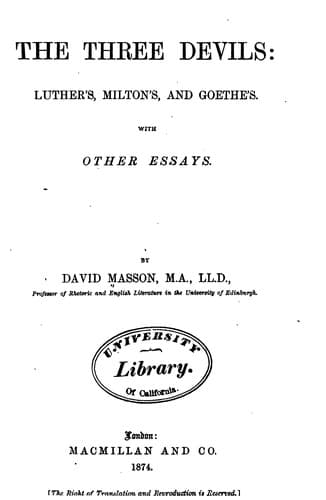
The Three Devils: Luther's, Milton's, and Goethe's; With Other EssaysMasson, David
History
The Three Devils: Luther's, Milton's, and Goethe's; With Other Essays
Masson, David
Devil in literature; Literature -- History and criticism
Nothing of this kind is to be found in Milton. As a Christian, indeed,
humiliation before God was a duty the meaning of which he knew full well;
but, as a man moving among other men, he possessed, in that moral
seriousness and stoic scorn of temptation which characterized him, a
spring of ever-present pride, dignifying his whole bearing among his
fellows, and at times arousing him to a kingly intolerance. In short,
instead of that dissatisfaction with self which we trace as a not
unfrequent feeling with Shakespeare, we find in Milton, even in his early
youth, a recollection firm and habitual that he was one of those servants
to whom God had entrusted the stewardship of ten talents. In that very
sonnet, for example, written on his twenty-third birthday, in which he
laments that he had as yet achieved so little, his consolation is that the
power of achievement was still indubitably within him--
"All is, if I have grace to use it so,
As ever in my great Task-Master's eye."
And what was that special mode of activity to which Milton, still in the
bloom and seed-time of his years, had chosen to dedicate the powers of
which he was so conscious? He had been destined by his parents for the
Church; but this opening into life he had definitively and deliberately
abandoned. With equal decision he renounced the profession of the Law; and
it does not seem to have been long after the conclusion of his career at
the university when he renounced the prospects of professional life
altogether. His reasons for this, which are to be gathered from various
passages of his writings, seem to have resolved themselves into a jealous
concern for his own absolute intellectual freedom. He had determined, as
he says, "to lay up, as the best treasure and solace of a good old age,
the honest liberty of free speech from his youth;" and neither the Church
nor the Bar of England, at the time when he formed that resolution, was a
place where he could hope to keep it. For a man so situated, the
alternative, then as now, was the practice or profession of literature. To
this, therefore, as soon as he was able to come to a decision on the
subject, Milton had implicitly, if not avowedly, dedicated himself. To
become a great writer, and, above all, a great poet; to teach the English
language a new strain and modulation; to elaborate and surrender over to
the English nation works that would make it more potent and wise in the
age that was passing, and more memorable and lordly in the ages to come:
such was the form which Milton's ambition had assumed when, laying aside
his student's garb, he went to reside under his father's roof.
Public-domain text, read in full here on John Shaqi.
Reviews
Reviews
No reviews yet
Be the first to share your thoughts on this work.
Elsewhere in the archive
Join the Discussion
Join the discussion
Sign in to leave a comment or review.
Sign InorCreate an account