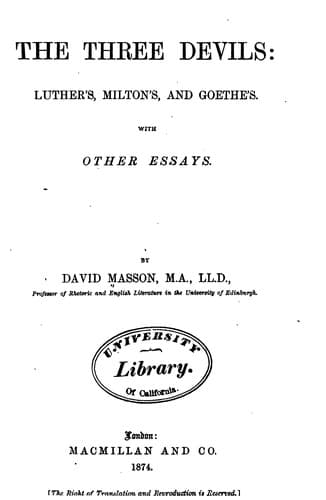
The Three Devils: Luther's, Milton's, and Goethe's; With Other EssaysMasson, David
History
The Three Devils: Luther's, Milton's, and Goethe's; With Other Essays
Masson, David
Devil in literature; Literature -- History and criticism
Such, we say, is Milton's habit in his later writings. In his early life,
of course, the feeling which it shows existed rather as an undefined
consciousness of superior power, a tendency silently and with satisfaction
to compare his own intellectual measure with that of others, a resolute
ambition to be and to do something great. Now we cannot help thinking
that it will be found that this particular form of self-esteem goes along
with that moral austerity of character which we have alleged to be
discernible in Milton even in his youth, rather than with that temperament
of varying sensibility which is, according to the general theory, regarded
as characteristic of the poet. Men of this latter type, as they vary in
the entire mood of their mind, vary also in their estimate of themselves.
No permanent consciousness of their own destiny, or of their own worth in
comparison with others, belongs to them. In their moods of elevation they
are powers to move the world; but, while the impulse that has gone forth
from them in one of those moods may be still thrilling its way onward in
wider and wider circles through the hearts of myriads they have never
seen, they, the fountains of the impulse, the spirit being gone from them,
may be sitting alone in the very spot and amid the ashes of their triumph,
sunken and dead, despondent and self-accusing. It requires the evidence of
positive results, the assurance of other men's praises, the visible
presentation of effects which they cannot but trace to themselves, to
convince such men that they are or can do anything. Whatever
manifestations of egotism, whatever strokes of self-assertion come from
such men, come in the very burst and phrenzy of their passing
resistlessness. The calm, deliberate, and unshaken knowledge of their own
superiority is not theirs. True, Shakespeare, the very type, if rightly
understood, of this class of minds, is supposed in his Sonnets to have
predicted, in the strongest and most deliberate terms, his own immortality
as a poet. It could be proved, however, were this the place for such an
investigation, that the common interpretation of those passages of the
Sonnets which are supposed to supply this trait in the character of
Shakespeare is nothing more nor less than a false reading of a very subtle
meaning which the critics have missed. Those other passages of the Sonnets
which breathe an abject melancholy and discontentment with self, which
exhibit the poet as "cursing his fate," as "bewailing his outcast state,"
as looking about abasedly among his literary contemporaries, envying the
"art" of one, and the "scope" of another, and even wishing sometimes that
the very features of his face had been different from what they were and
like those of some he knew, are, in our opinion, of far greater
autobiographic value.
Public-domain text, read in full here on John Shaqi.
Reviews
Reviews
No reviews yet
Be the first to share your thoughts on this work.
Elsewhere in the archive
Join the Discussion
Join the discussion
Sign in to leave a comment or review.
Sign InorCreate an account