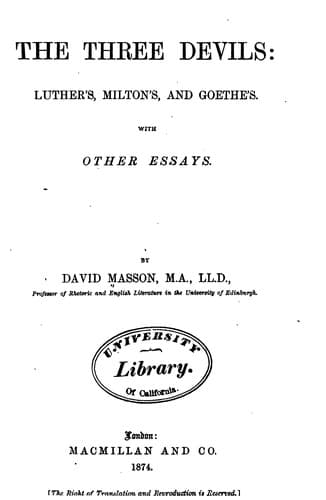
The Three Devils: Luther's, Milton's, and Goethe's; With Other EssaysMasson, David
History
The Three Devils: Luther's, Milton's, and Goethe's; With Other Essays
Masson, David
Devil in literature; Literature -- History and criticism
He knew this, he says, by "certain vital signs" discernible in what he had
already written. What were those "vital signs," those proofs indubitable
to Milton that he had the art and faculty of a poet? We need but refer the
reader for the answer to those smaller poetical compositions of Milton,
both in English and in Latin, which survive as specimens of his earliest
Muse. Of these, some three or four which happen to be specially
dated--such as the _Elegy on the Death of a Fair Infant_, written in 1626,
or the author's eighteenth year; the well-known _Hymn on the Morning of
Christ's Nativity_, written in 1629, when the author was just twenty-one;
and the often-quoted _Lines on Shakespeare_, written not much later--may
be cited as convenient materials from which anyone who would convince
himself minutely of Milton's youthful vocation to poetry, rather than to
anything else, may derive proofs on that head. Here will be found power of
the most rare and beautiful conception, choice of words the most exact and
exquisite, the most perfect music and charm of verse. Above all, here will
be found that ineffable something--call it imagination or what we
will--wherein lies the intimate and ineradicable peculiarity of the poet:
the art to work on and on for ever in a purely ideal element, to chase and
marshal airy nothings according to a law totally unlike that of rational
association, never hastening to a logical end like the schoolboy when on
errand, but still lingering within the wood like the schoolboy during
holiday. This peculiar mental habit, nowhere better described than by
Milton himself when he speaks of verse
"Such as the meeting soul may pierce,
In notes with many a winding bout
Of linkèd sweetness long drawn out
With wanton heed and giddy cunning,"
is so characteristic of the poetical disposition that, though in most of
the greatest poets, as, for example, Dante, Goethe, Shakespeare in his
dramas, Chaucer, and almost all the ancient Greek poets, it is not
observable in any extraordinary degree, chiefly because in them the
element of direct reference to human life and its interests had fitting
preponderance, yet it may be affirmed that he who, tolerating or admiring
these poets, does not relish also such poetry as that of Spenser, Keats,
and Shakespeare in his minor pieces, but complains of it as wearisome and
sensuous, is wanting in a portion of the genuine poetic taste.
Public-domain text, read in full here on John Shaqi.
Reviews
Reviews
No reviews yet
Be the first to share your thoughts on this work.
Elsewhere in the archive
Join the Discussion
Join the discussion
Sign in to leave a comment or review.
Sign InorCreate an account