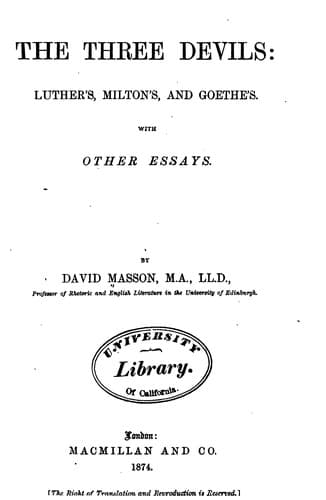
The Three Devils: Luther's, Milton's, and Goethe's; With Other EssaysMasson, David
History
The Three Devils: Luther's, Milton's, and Goethe's; With Other Essays
Masson, David
Devil in literature; Literature -- History and criticism
There was but one "vital sign" the absence of which in Milton could,
according to any theory of the poetical character, have begotten doubts in
his own mind, or in the minds of his friends, whether poetry was his
peculiar and appropriate function. The single source of possible doubt on
this head could have been no other than that native austerity of feeling
and temper, that real though not formal Puritanism of heart and
intellect, which we have noticed as distinguishing Milton from his youth
upward. The poet, it is said in these days, when, by psychologizing a man,
it is supposed we can tell what course of life he is fit for--the poet
ought to be universally sympathetic; he ought to hate nothing, despise
nothing. And a notion equivalent to this, though by no means so
articulately expressed, was undoubtedly prevalent in Milton's own time. As
the Puritans, on the one hand, had set their faces against all those
practices of profane singing, dancing, masquing, theatre-going, and the
like, in which the preservation of the spirit of the arts was supposed to
be involved, so the last party in the world from which the reputed
devotees of the arts in those days would have expected a poet to arise was
that of the Puritans. Even in Shakespeare, and much more in Ben Jonson,
Beaumont and Fletcher, and other poets of the Elizabethan age, may be
traced evidences of an instinctive enmity to that Puritanical mode of
thinking which was then on the increase in English society, and in the
triumph of which those great minds foresaw the proscription of their craft
and their pleasures. When Sir Toby says to Malvolio, "Dost thou think,
because thou art virtuous, there shall be no more cakes and ale?" and when
the Clown adds, "Yes, by Saint Anne, and ginger shall be hot i' the mouth
too," it is the Knight and the Clown on the one side against Malvolio the
Puritan on the other. That the defence of the festive in this passage is
not borne by more respectable personages than the two who speak is indeed
a kind of indication that Shakespeare's personal feelings with regard to
the austere movement which he saw gathering around him were by no means so
deep or bitter as to discompose him; but, if his profounder soul could
behold such things with serenity, and even pronounce them good, they
assuredly met with enough of virulence and invective among his lesser
contemporaries. That literary crusade against the Puritans, as canting,
sour-visaged, mirth-forbidding, art-abhorring religionists, which came to
its height at the time when Butler wrote his _Hudibras_, and Wycherley his
plays, was already hot when the wits of King James's days used to assemble
after the theatre, in their favourite taverns; and if, sallying out after
one of their merry evenings in their most favourite tavern of all, the
Mermaid in Bread Street, those assembled poets and dramatists had gone in
search of the youth who was likeliest to be the poet of the age then
Public-domain text, read in full here on John Shaqi.
Reviews
Reviews
No reviews yet
Be the first to share your thoughts on this work.
Elsewhere in the archive
Join the Discussion
Join the discussion
Sign in to leave a comment or review.
Sign InorCreate an account