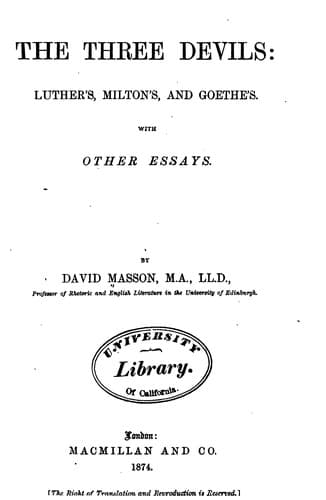
The Three Devils: Luther's, Milton's, and Goethe's; With Other EssaysMasson, David
History
The Three Devils: Luther's, Milton's, and Goethe's; With Other Essays
Masson, David
Devil in literature; Literature -- History and criticism
First, then, it was not _humour_ that came to the rescue, in Milton's
case, to help him out in those respects wherein, according to the theory
in question, the strictness and austerity of his own disposition would
have injured his capacity to be a poet. There are and have been men as
strict and austere as he, who yet, by means of this quality of humour,
have been able to reconcile themselves to much in human life lying far
away from, and even far beneath, the sphere of their own practice and
conscientious liking. As Pantagruel, the noble and meditative, endured and
even loved those immortal companions of his, the boisterous and profane
Friar John, and the cowardly and impish Panurge, so these men, remaining
themselves with all rigour and punctuality within the limits of sober and
exemplary life, are seen extending their regards to the persons and the
doings of a whole circle of reprobate Falstaffs, Pistols, Clowns, and Sir
Toby Belches. They cannot help it. They may and often do blame themselves
for it; they wish that, in their intercourse with the world, they could
more habitually turn the austere and judicial side of their character to
the scenes and incidents that there present themselves, simply saying of
each "That is right and worthy" or "That is wrong and unworthy," and
treating it accordingly. But they break down in the trial. Suddenly some
incident presents itself which is not only right but clumsy, or not only
wrong but comic, and straightway the austere side of their character
wheels round to the back, and judge, jury, and witnesses are convulsed
with untimely laughter. It was by no means so with Milton. As his critics
have generally remarked, he had little of humour, properly so called, in
his composition. His laughter is the laughter of scorn. With one unvarying
judicial look he confronted the actions of men, and, if ever his tone
altered as he uttered his judgments, it was only because something roused
him to a pitch of higher passion. Take, as characteristic, the following
passage, in which he replies to the taunt of an opponent who had asked
where _he_, the antagonist of profane amusements, had procured that
knowledge of theatres and their furniture which certain allusions in one
of his books showed him to possess:--
Public-domain text, read in full here on John Shaqi.
Reviews
Reviews
No reviews yet
Be the first to share your thoughts on this work.
Elsewhere in the archive
Join the Discussion
Join the discussion
Sign in to leave a comment or review.
Sign InorCreate an account