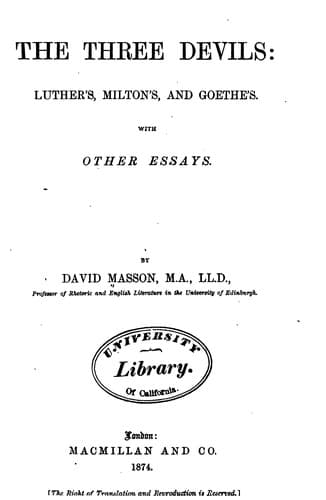
The Three Devils: Luther's, Milton's, and Goethe's; With Other EssaysMasson, David
History
The Three Devils: Luther's, Milton's, and Goethe's; With Other Essays
Masson, David
Devil in literature; Literature -- History and criticism
"Since there is such necessity to the hearsay of a tire, a periwig,
or a vizard, that plays must have been seen, what difficulty was
there in that, when in the colleges so many of the young divines, and
those in next aptitude to divinity, have been seen so often upon the
stage, writhing and unboning their clergy limbs to all the antic and
dishonest gestures of Trinculoes, buffoons, and bawds, prostituting
the shame of that ministry which either they had or were nigh having
to the eyes of courtiers and court ladies, with their grooms and
mademoiselles? There, whilst they acted and overacted, among other
young scholars, I was a spectator: they thought themselves gallant
men, and I thought them fools; they made sport, and I laughed; they
mispronounced, and I misliked; and, to make up the atticism, they
were out, and I hissed."--_Apology for Smectymnuus._
Who can doubt that to a man to whom such a scene as this presented itself
in a light so different from that in which a Shakespeare would have viewed
it Friar John himself, if encountered in the real world, would have been
simply the profane and unendurable wearer of the sacred garb, Falstaff
only a foul and grey-haired iniquity, Pistol but a braggart and coward,
and Sir Toby Belch but a beastly sot?
That office, however, which humour did not perform for Milton, in his
intercourse with the world of past and present things, was in part
performed by what he did in large measure possess--intellectual
_inquisitiveness_: respect for intellect, its accomplishments, and its
rights. If any quality in the actions or writings of other men could have
won Milton's favourable regards, even where his moral sense condemned,
that quality, we believe, was intellectual greatness, and especially
greatness of his own stamp, or marked by any of his own features. Hence
that tone of almost pitying admiration which pervades his representation
of the ruined Archangel; hence his uniformly respectful references to the
great intellects of Paganism and of the Catholic world; and hence, we
think, his unbounded and, for a time at least, unqualified reverence for
Shakespeare. As by the direct exercise of his own intellect, on the one
hand, applied to the rational discrimination for himself of what was
really wrong from what was only ignorantly reputed to be so, he had kept
his mind clear, as Cromwell also did, from many of those sectarian
prejudices in the matter of moral observance which were current in his
time--justified, for example, his love of music, his liking for natural
beauty, his habits of cheerful recreation, his devotion to various
literature, and even, most questionable of all, as would then have been
thought, his affection for the massy pillars and storied windows of
ecclesiastical architecture,--so, reflexly, by a recognition of the
intellectual liberty of others, he seems to have distinctly apprehended
Public-domain text, read in full here on John Shaqi.
Reviews
Reviews
No reviews yet
Be the first to share your thoughts on this work.
Elsewhere in the archive
Join the Discussion
Join the discussion
Sign in to leave a comment or review.
Sign InorCreate an account