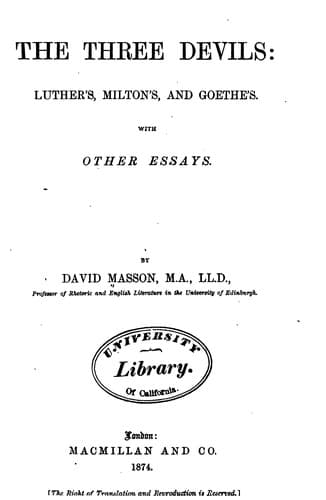
The Three Devils: Luther's, Milton's, and Goethe's; With Other EssaysMasson, David
History
The Three Devils: Luther's, Milton's, and Goethe's; With Other Essays
Masson, David
Devil in literature; Literature -- History and criticism
Here, at last, therefore, we have Milton's own judgment on the matter of
our inquiry. He had speculated himself on that subject; he had made it a
matter of conscious investigation what kind of moral tone and career would
best fit a man to be a poet, on the one hand, or would be most likely to
frustrate his hopes of writing well, on the other; and his conclusion, as
we see, was dead against the "wild oats" theory. Had Ben Jonson,
according to our previous fancy, proffered him, out of kindly interest, a
touch of that theory, while criticising his juvenile poems, and telling
him how he might learn to write better, there would have descended on the
lecturer, as sure as fate, a rebuke, though from young lips, that would
have made his strong face blush. "_He who would not be frustrate of his
hope to write well hereafter in laudable things ought himself to be a true
poem_:" fancy that sentence, an early and often pronounced formula of
Milton's, as we may be sure it was, hurled some evening, could time and
chance have permitted it, into the midst of the assembled Elizabethan wits
at the Mermaid! What interruption of the jollity, what mingled uneasiness
and resentment, what turning of faces towards the new speaker, what forced
laughter to conceal consternation! Only Shakespeare, one thinks, had he
been present, would have fixed on the bold youth a mild and approving eye,
would have looked round the room thoroughly to observe the whole scene,
and, remembering some passages in his own life, would mayhap have had his
own thoughts! Certainly, at least, the essence of that wonderful and
special development of the literary genius of England which came between
the Elizabethan epoch and the epoch of the Restoration, and which was
represented and consummated in Milton himself, consisted in the fact that
then there was a temporary protest, and by a man able to make it good,
against the theory of "wild oats," current before and current since. The
nearest poet to Milton in this respect, since Milton's time, has
undoubtedly been Wordsworth.
DRYDEN, AND THE LITERATURE OF THE RESTORATION.
DRYDEN, AND THE LITERATURE OF THE RESTORATION.[6]
Public-domain text, read in full here on John Shaqi.
Reviews
Reviews
No reviews yet
Be the first to share your thoughts on this work.
Elsewhere in the archive
Join the Discussion
Join the discussion
Sign in to leave a comment or review.
Sign InorCreate an account