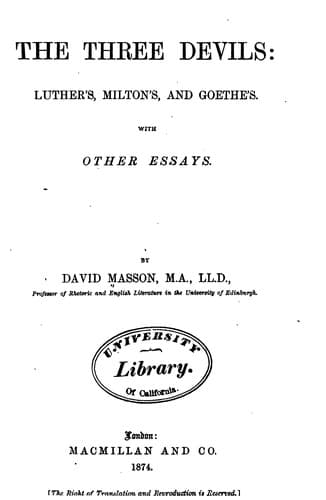
The Three Devils: Luther's, Milton's, and Goethe's; With Other EssaysMasson, David
History
The Three Devils: Luther's, Milton's, and Goethe's; With Other Essays
Masson, David
Devil in literature; Literature -- History and criticism
"Whence, having observed them [the elegiac and love poets] to account
it the chief glory of their wit, in that they were ablest to judge,
to praise, and by that could esteem themselves worthiest to love,
those high perfections which, under one or other name, they took to
celebrate, I thought with myself, by every instinct and presage of
nature (which is not wont to be false), that what emboldened them to
this task might, with such diligence as they used, embolden me, and
that what judgment, wit, or elegance was my share would herein best
appear, and best value itself, by how much more wisely and with more
love of virtue I should choose (let rude ears be absent!) the object
of not unlike praises. For, albeit these thoughts to some will seem
virtuous and commendable, to others only pardonable, to a third sort
perhaps idle, yet the mentioning of them now will end in serious. Nor
blame it, readers, in those years to propose to themselves such a
reward as the noblest dispositions above other things in this life
have sometimes preferred; whereof not to be sensible, when good and
fair in one person meet, argues both a gross and shallow judgment,
and withal an ungentle and swainish breast. For, by the firm settling
of these persuasions, I became, to my best memory, so much a
proficient that, if I found those authors anywhere speaking unworthy
things of themselves, or unchaste those names which before they had
extolled, this effect it wrought in me: From that time forward their
art I still applauded, but the men I deplored; and above them all
preferred the two famous renowners of Beatrice and Laura, who never
wrote but honour of them to whom they devote their verse, displaying
sublime and pure thoughts without transgression. And long it was not
after when I was confirmed in this opinion, that he who would not be
frustrate of his hope to write well hereafter in laudable things
ought himself to be a true poem--that is, a composition and pattern
of the best and honourablest things; not presuming to sing high
praises of heroic men or famous cities unless he have in himself the
experience and the practice of all that which is
praiseworthy."--_Apology for Smectymnuus._
Public-domain text, read in full here on John Shaqi.
Reviews
Reviews
No reviews yet
Be the first to share your thoughts on this work.
Elsewhere in the archive
Join the Discussion
Join the discussion
Sign in to leave a comment or review.
Sign InorCreate an account