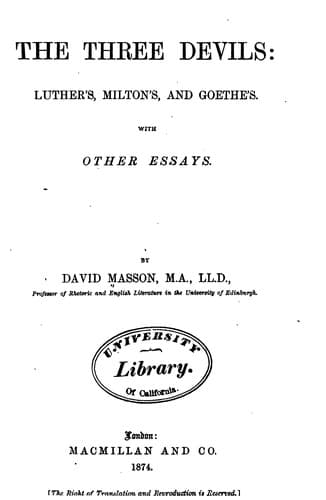
The Three Devils: Luther's, Milton's, and Goethe's; With Other EssaysMasson, David
History
The Three Devils: Luther's, Milton's, and Goethe's; With Other Essays
Masson, David
Devil in literature; Literature -- History and criticism
of mind at work, and as much, on the whole, may be written as before; but
the very excess of what may be called the pamphlet literature, which is
perishable in its nature, will leave a deficiency in the various
departments of literature more strictly so called--philosophical or
expository literature, historical literature, and the literature of pure
imagination. Not till the turmoil is over, not till the battle has been
fairly fought out, and the mental activity involved in it has been let
loose for more scattered work, will the calmer muses resume their sway,
and the press send forth treatises and histories, poems and romances, as
well as pamphlets. Then, however, men may return to literature with a new
zest, and the very storm which has interrupted the course of pure
literature for a time may infuse into such literature, when it begins
again, a fresher and stronger spirit. If the battle has ended in a
victory, there will be a tone of joy, of exultation, and of scorn, in what
men think and write after it; if it has ended in a defeat, all that is
thought and written will be tinged by a deeper and finer sorrow.
The history of English literature affords some curious illustrations of
this law. It has always puzzled historians, for example, to account for
such a great unoccupied gap in our literary progress as occurs between the
death of Chaucer and the middle of the reign of Elizabeth. From the year
1250, when the English language first makes its appearance in anything
like its present form, to the year 1400, when Chaucer died, forms, as all
know, the infant age of our literature. It was an age of great literary
activity; and how much was achieved in it remains apparent in the fact
that it culminated in a man like Chaucer--a man whom, without any drawback
for the early epoch at which he lived, we still regard as one of our
literary princes. Nor was Chaucer the solitary name of his age. He had
some notable contemporaries, both in verse and in prose. When we pass from
Chaucer's age, however, we have to overleap nearly a hundred and eighty
years before we alight upon a period presenting anything like an adequate
show of literary continuation. A few smaller names, like those of
Lydgate, Surrey, and Skelton, are all that can be cited as poetical
representatives of this sterile interval in the literary history of
England: whatever of Chaucer's genius still lingered in the island seeming
to have travelled northward, and taken refuge in a series of Scottish
poets, excelling any of their English contemporaries. How is this to be
accounted for? Is it that really, during this period, there was less of
available mind than before in England, that the quality of the English
nerve had degenerated? By no means necessarily so. Englishmen, during this
period were engaged in enterprises requiring no small amount of
intellectual and moral vigour; and there remain to us, from the same
period, specimens of grave and serious prose, which, if we do not place
Public-domain text, read in full here on John Shaqi.
Reviews
Reviews
No reviews yet
Be the first to share your thoughts on this work.
Elsewhere in the archive
Join the Discussion
Join the discussion
Sign in to leave a comment or review.
Sign InorCreate an account