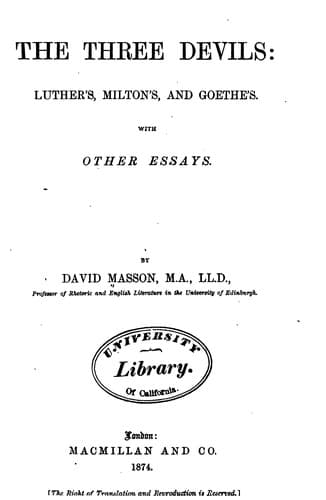
The Three Devils: Luther's, Milton's, and Goethe's; With Other EssaysMasson, David
History
The Three Devils: Luther's, Milton's, and Goethe's; With Other Essays
Masson, David
Devil in literature; Literature -- History and criticism
them among the gems of our literature, we at least regard as evidence that
our ancestors of those days were men of heart and wit and solid sense. In
short, we are driven to suppose that there was something in the social
circumstances of England during the long period in question which
prevented such talent as there was from assuming the particular form of
literature. Fully to make out what this "something" was may baffle us;
but, when we remember that this was the period of the Civil Wars of the
Roses, and also of the great Anglican Reformation, we have reason enough
to conclude that the dearth of pure literature may have been owing, in
part, to the engrossing nature of those practical questions which then
disturbed English society. When Chaucer wrote, England, under the splendid
rule of the third Edward, was potent and triumphant abroad, but large and
leisurely at home; but scarcely had that monarch vacated the throne when a
series of civil jars began, which tore the nation into factions, and was
speedily followed by a religious movement as powerful in its effects.
Accordingly, though printing was introduced during this period, and thus
Englishmen had greater temptations to write, what they did write was
almost exclusively plain grave prose, intended for practical or polemical
occasions, and making no figure in a historical retrospect. How different
when, passing the controversial reigns of Henry VIII., Edward VI., and
Mary, we come upon the golden days of Queen Bess! Controversy enough
remained to give occasion to plenty of polemical prose; but about the
middle of her reign, when England, once more great and powerful abroad as
in the time of the Edwards, settled down within herself into a new lease
of social order and leisure under an ascertained government, there began
an outburst of literary genius such as no age or country had ever before
witnessed. The literary fecundity of that period of English history which
embraces the latter half of the reign of Elizabeth and the whole of the
reign of James I. (1580-1625) is a perpetual astonishment to us all. In
the entire preceding three centuries and a half we can with difficulty
name six men that can, by any charity of judgment, be regarded as stars in
our literature, and of these only one that is a star of the first
magnitude: whereas in this brief period of forty-five or fifty years we
can reckon up a host of poets and prose-writers all noticeable on high
literary grounds, and of whom at least thirty were men of extraordinary
dimensions. Indeed, in the contemplation of the intellectual abundance and
variety of this age--the age of Spenser, Shakespeare, and Bacon, of
Raleigh and Hooker, of Ben Jonson, Beaumont and Fletcher, Donne, Herbert,
Massinger, and their illustrious contemporaries--we feel ourselves driven
from the theory that so rich a literary crop could have resulted from that
mere access of social leisure after a long series of national broils to
Public-domain text, read in full here on John Shaqi.
Reviews
Reviews
No reviews yet
Be the first to share your thoughts on this work.
Elsewhere in the archive
Join the Discussion
Join the discussion
Sign in to leave a comment or review.
Sign InorCreate an account