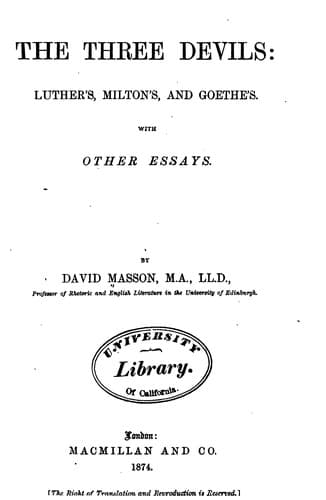
The Three Devils: Luther's, Milton's, and Goethe's; With Other EssaysMasson, David
History
The Three Devils: Luther's, Milton's, and Goethe's; With Other Essays
Masson, David
Devil in literature; Literature -- History and criticism
Had Cromwell lived longer, or had he established a dynasty capable of
maintaining itself, there can be little doubt that there would have come a
time of leisure during which, even under a Puritan rule, there would have
been a new outburst of English Literature. There were symptoms, towards
the close of the Protectorate that Cromwell, having now "reasonable good
leisure," was willing and even anxious that the nation should resume its
old literary industry and all its innocent liberties and pleasures. He
allowed Cowley, Waller, Denham, Davenant, and other Royalists, to come
over from France, and was glad to see them employed in writing verses.
Waller became one of his courtiers, and composed panegyrics on him. He
released Cleveland from prison in a very handsome manner, considering what
hard things the witty roysterer had written about "O.P." and his "copper
nose." He appears even to have winked at Davenant, when, in violation of
the act against stage-plays, that gentlemanly poet began to give private
theatrical entertainments under the name of operas. Davenant's heretical
friend, Hobbes, too, already obnoxious by his opinions even to his own
political party, availed himself of the liberty of the press to issue some
fresh metaphysical essays, which the Protector may have read. In fact, had
Cromwell survived a few years, there would, in all probability, have
arisen, under his auspices, a new literature, of which his admirer and
secretary, Milton, would have been the laureate. What might have been the
characteristics of this literature of the Commonwealth, had it developed
itself to full form and proportions, we can but guess. That, in some
respects, it would not have been so broad and various as the literature
which took its rise from the Restoration is very likely; for, so long as
the Puritan element remained dominant in English society, it was
impossible that, with any amount of liberty of the press, there should
have been such an outbreak of the merely comic spirit as did occur when
that element succumbed to its antagonist, and genius had official licence
to be as profligate as it chose. But, if less gay and riotous, it might
have been more earnest, powerful, and impressive. For its masterpiece it
would still have had _Paradise Lost_,--a work which, as it is, we must
regard as its peculiar offspring, though posthumously born; nor can we
doubt that, if influenced by the example and the recognised supremacy of
such a laureate as Milton, the younger literary men of the time would have
found themselves capable of other things than epigrams and farces.
Public-domain text, read in full here on John Shaqi.
Reviews
Reviews
No reviews yet
Be the first to share your thoughts on this work.
Elsewhere in the archive
Join the Discussion
Join the discussion
Sign in to leave a comment or review.
Sign InorCreate an account