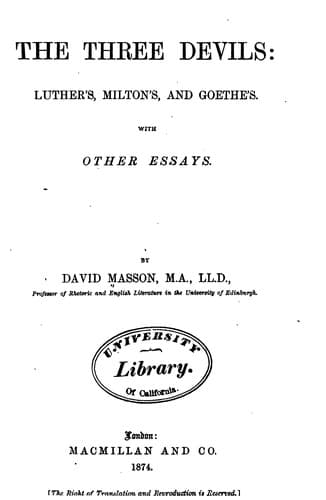
The Three Devils: Luther's, Milton's, and Goethe's; With Other EssaysMasson, David
History
The Three Devils: Luther's, Milton's, and Goethe's; With Other Essays
Masson, David
Devil in literature; Literature -- History and criticism
this period is inconsiderable in quantity, and dashed with a vein of
polemical allusion rendering it hardly an exception to the rule. The
literary career of Milton illustrates very strikingly this fact of the all
but entire cessation of pure literature in England between 1640 and 1660.
Milton's life consists of three distinctly marked periods--the first
ending with 1640, during which he composed his exquisite minor poems; the
second extending precisely from 1640 to 1660, during which he wrote no
poetry at all, except a few sonnets, but produced his various polemical
prose treatises or pamphlets, and served the state as a public
functionary; and the third, which may be called the period of his later
muse, extending from 1660 to his death in 1674, and famous for the
composition of his greater poems. Thus Milton's prose-period, if we may so
term it, coincided exactly with the period of civil strife and Cromwellian
rule. And, if this was the case with Milton--if he, who was essentially
the poet of Puritanism, with his whole heart and soul in the struggle
which Cromwell led, was obliged, during the process of that struggle, to
lay aside his singing robes, postpone his plans of a great immortal poem,
and in the meanwhile drudge laboriously as a prose pamphleteer--how much
more must those have been reduced to silence, or brought down into
practical prose, who found no such inspiration in the movement as it gave
to the soul of Milton, but regarded it all as desolation and disaster!
Indeed, one large department of the national literature at this period was
proscribed by civil enactment. Stage-plays were prohibited in 1642, and it
was not till after the Restoration that the theatres were re-opened. Such
a prohibition, though it left the sublime muse of Milton at liberty, had
it cared to sing, was a virtual extinction for the time of all the
customary literature. In fine, if all the literary produce of England in
the interval between 1640 and 1660 is examined, it will be found to
consist in the main of a huge mass of controversial prose, by far the
greater proportion of which, though effective at the time, is little
better now than antiquarian rubbish, astonishing from its bulk, though
some small percentage including all that came from the terrible pen of
Milton is saved by reason of its strength and grandeur. The intellect of
England was as active and as abundant as ever, but it was all required for
the current service of the time. Perhaps the only exception of any
consequence was in the case of the philosophical and calm-minded Sir
Thomas Browne, author of the _Religio Medici_. While all England was in
throes and confusion Browne was quietly attending his patients, or
pottering along his garden at Norwich, or pursuing his meditations about
sepulchral urns and his inquiries respecting the Quincuncial Lozenge. His
views of things might have been considerably quickened by billeting upon
his household a few of the Ironsides.
Public-domain text, read in full here on John Shaqi.
Reviews
Reviews
No reviews yet
Be the first to share your thoughts on this work.
Elsewhere in the archive
Join the Discussion
Join the discussion
Sign in to leave a comment or review.
Sign InorCreate an account