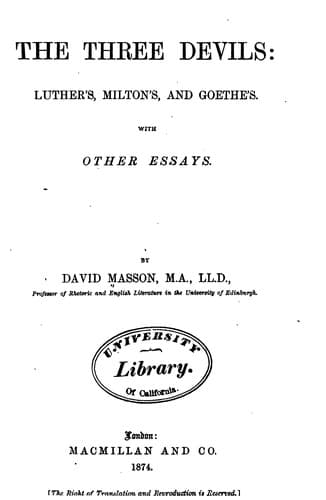
The Three Devils: Luther's, Milton's, and Goethe's; With Other EssaysMasson, David
History
The Three Devils: Luther's, Milton's, and Goethe's; With Other Essays
Masson, David
Devil in literature; Literature -- History and criticism
greatest prose allegory in the language. Close about the person of the
king, too, there were able men and wits, capable of writing themselves, or
of criticising what was written by others, from the famous Clarendon down
to such younger and lighter men as Dillon, Earl of Roscommon, Sackville,
Earl of Dorset, and Sir Charles Sedley. Lastly, not to extend the list
farther, there was then in London, aged twenty-nine, and going about in a
stout plain dress of grey drugget, a Northamptonshire squire's son, named
John Dryden, who, after having been educated at Cambridge, had come up to
town in the last year of the Protectorate to push his fortune under a
Puritan relative then in office, and who had already once or twice tried
his hand at poetry. Like Waller, he had written and published a series of
panegyrical stanzas on Cromwell after his death; and, like Waller also, he
had attempted to atone for this miscalculation by writing another poem,
called _Astræa Redux_, to celebrate the return of Charles. As a taste of
what this poet, in particular, could do, take the last of his stanzas on
Cromwell:--
"His ashes in a peaceful urn shall rest;
His name a great example stands to show
How strangely high endeavours may be blessed,
Where piety and valour jointly go";
or, in another metre and another strain of politics, the conclusion of the
poem addressed to Charles:--
"The discontented now are only they
Whose crimes before did your just cause betray:
Of those your edicts some reclaim from sin,
But most your life and blest example win.
Oh happy prince! whom Heaven hath taught the way
By paying vows to have more vows to pay!
Oh happy age! Oh times like those alone
By fate reserved for great Augustus' throne,
When the joint growth of arms and arts foreshow
The world a monarch, and that monarch you!"
Such were the _personal elements_, if we may so call them, available at
the beginning of the reign of Charles II. for the commencement of a new
era in English literature. Let us see next what were the more pronounced
_tendencies_ visible amid these personal elements--in other words, what
tone of moral sentiment, and what peculiarities of literary style and
method, were then in the ascendant, and likely to determine the character
of the budding authorship.
Public-domain text, read in full here on John Shaqi.
Reviews
Reviews
No reviews yet
Be the first to share your thoughts on this work.
Elsewhere in the archive
Join the Discussion
Join the discussion
Sign in to leave a comment or review.
Sign InorCreate an account