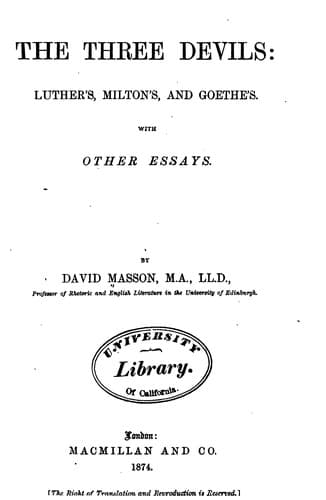
The Three Devils: Luther's, Milton's, and Goethe's; With Other EssaysMasson, David
History
The Three Devils: Luther's, Milton's, and Goethe's; With Other Essays
Masson, David
Devil in literature; Literature -- History and criticism
It was pre-eminently clear that the forthcoming literature would be
Royalist and anti-Puritan. With the exception of Milton, there was not one
man of known literary power whose heart still beat as it did when Cromwell
sat on the throne, and whose muse magnanimously disdained the change that
had befallen the nation. Puritanism, as a whole, was driven back into the
concealed vitals of the community, to sustain itself meanwhile as a
sectarian theology lurking in chapels and conventicles, and only to
re-appear after a lapse of years as an ingredient in the philosophy of
Locke and his contemporaries. The literary men who stepped forward to lead
the literature of the Restoration were royalists and courtiers: some of
them honest cavaliers, rejoicing at being let loose from the restraints of
the Commonwealth; others timeservers, making up for delay by the fulsome
excess of their zeal for the new state of things. It was part of this
change that there should be an affectation, even where there was not the
reality, of lax morals. According to the sarcasm of the time, it was
necessary now for those who would escape the risk of being thought
Puritans to contract a habit of swearing and pretend to be great rakes.
And this increase, both in the practice and in the profession of
profligacy, at once connected itself with that institution of English
society which, from the very fact that it had been suppressed by the
Puritans, now became doubly attractive and popular. The same revolution
which restored royalty in England re-opened the play-houses; and in them,
as the established organs of popular sentiment, all the anti-Puritanic
tendencies of the time hastened to find vent. The custom of having female
actors on the stage for female parts, instead of boys as heretofore, was
now permanently introduced, and brought many scandals along with it.
Whether, as some surmise, the very suppression of the theatres during the
reign of Puritanism contributed to their unusual corruptness when they
were again allowed by law--by damming up, as it were, a quantity of
pruriency which had afterwards to be let loose in a mass--it is not easy
to say; it is certain, however, that never in this country did impurity
run so openly at riot in literary guise as it did in the Drama of the
Restoration. To use a phrenological figure, it seemed as if the national
cranium of England had suddenly been contracted in every other direction
so as to permit an inordinate increase of that particular region which is
situated above the nape of the neck. This enormous preponderance of the
back of the head in literature was most conspicuously exhibited in Comedy.
Every comedy that was produced represented life as a meagre action of
persons and interests on a slight proscenium of streets and bits of green
field, behind which lay the real business, transacted in stews. To set
against this, it is true, there was a so-called Tragic Drama. The tragedy
Public-domain text, read in full here on John Shaqi.
Reviews
Reviews
No reviews yet
Be the first to share your thoughts on this work.
Elsewhere in the archive
Join the Discussion
Join the discussion
Sign in to leave a comment or review.
Sign InorCreate an account