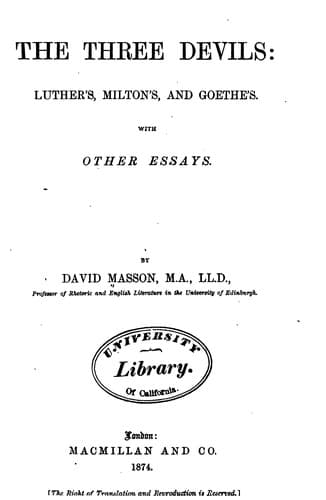
The Three Devils: Luther's, Milton's, and Goethe's; With Other EssaysMasson, David
History
The Three Devils: Luther's, Milton's, and Goethe's; With Other Essays
Masson, David
Devil in literature; Literature -- History and criticism
These remarks are necessary to prepare us for conceiving the Satan of
Milton. Except, as we have said, for an occasional feeling during a
perusal of the poem that the style of thinking and speculating about the
issue of their enterprise is too meagre and human for a race of beings
physically so superhuman, one's astonishment at the consistency of the
poet's conceptions is unmitigated throughout. Such keeping is there
between one conception and another, such a distinct material grasp had the
poet of his whole subject, so little is there of the mystic or the hazy in
his descriptions from beginning to end, that it would be quite possible to
prefix to the _Paradise Lost_ an illustrative diagram exhibiting the
universal space in which Milton conceived his beings moving to and fro,
divided, as he conceived it, at first into two or three, and afterwards
into four tropics or regions. Then his narrative is so clear that a brief
prose version of it would be a history of Satan in the interval between
his own fall and the fall of Man.
It is to be noted that Milton as a poet proceeds on the Homeric method,
and not on the Shakespearian, devoting the whole strength of his genius to
the object, not of being discursive and original, not of making profound
remarks on everything as he goes along, but of carrying on a sublime and
stately narrative. We should hardly be led to assert, however, that the
difference between the epic and the drama lies in this, that the latter
may be discursive and reflective while the former cannot. We can conceive
an epic written after the Shakespearian method; that is, one which, while
strictly sustaining a narrative, should be profoundly expository in its
spirit. Certain it is, however, that Milton wrote after the Homeric
method, and did not exert himself chiefly in strewing his text with
luminous propositions. One consequence of this is that the way to obtain
an idea of Milton's Satan is not to lay hold of specific sayings that fall
from his mouth, but to go through his history. Goethe's Mephistopheles, we
shall find, on the other hand, reveals himself in the characteristic
propositions which he utters. Satan is to be studied by following his
progress; Mephistopheles by attending to his remarks.
Public-domain text, read in full here on John Shaqi.
Reviews
Reviews
No reviews yet
Be the first to share your thoughts on this work.
Join the Discussion
Join the discussion
Sign in to leave a comment or review.
Sign InorCreate an account