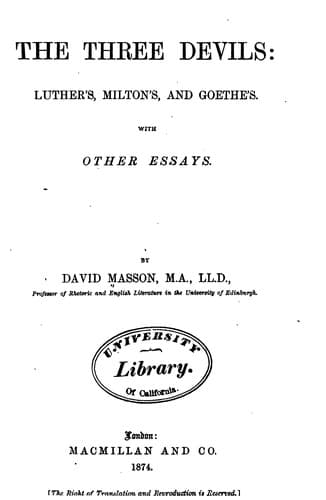
The Three Devils: Luther's, Milton's, and Goethe's; With Other EssaysMasson, David
History
The Three Devils: Luther's, Milton's, and Goethe's; With Other Essays
Masson, David
Devil in literature; Literature -- History and criticism
hundred and fifteen, including such scientific celebrities of the time as
Boyle, Wallis, Wilkins, Christopher Wren, Dr. Isaac Barrow, Evelyn, and
Hooke, besides such titled amateurs of experimental science as the Duke of
Buckingham, the Marquis of Dorchester, the Earls of Devonshire, Crawford,
and Northampton, and Lords Brouncker, Cavendish, and Berkeley. Among the
more purely literary members were Waller, Denham, Cowley, and Sprat,
afterwards Bishop of Rochester. The admission of Dryden into such company
is a proof that already he was socially a man of mark. As we have Dryden's
own confession that he was somewhat dull and sluggish in conversation, and
the testimony of others that he was the very reverse of a bustling or
pushing man, and rather avoided society than sought it, we must suppose
that he had been found out in spite of himself. We can fancy him at
Herringman's, or elsewhere, sitting as one of a group with Davenant,
Howard, and others, taking snuff and listening, rather than speaking, and
yet, when he did speak, doing so with such judgment as to make his chair
one of the most important in the room, and impress all with the conviction
that he was a solid fellow. He seems also to have taken an interest in the
scientific gossip of the day about magnetism, the circulation of the
blood, and the prospects of the Baconian system of philosophy; and this
may have helped to bring him into contact with men like Boyle, Wren, and
Wallis. At all events, if the Society elected him on trust, he soon
justified their choice by taking his place among the best known members
of what was then the most important class of literary men--the writers for
the stage. His first drama, a lumbering prose-comedy entitled _The Wild
Gallant_, was produced at Killigrew's Theatre in February, 1662-3; and,
though its success was very indifferent, he was not discouraged from a
second venture in a tragi-comedy, entitled _The Rival Ladies_, written
partly in blank verse, partly in heroic rhyme, and produced at the same
theatre. This attempt was more successful; and in 1664 there was produced,
as the joint composition of Dryden and Sir Robert Howard, an attempt in
the style of the regular heroic or rhymed tragedy, called _The Indian
Queen_. The date of this effort of literary co-partnership between Dryden
and his aristocratic friend coincides with the formation of a more
intimate connexion between them, by Dryden's marriage with Sir Robert's
sister, Lady Elizabeth Howard. The marriage (the result, it would seem, of
a visit of the poet, in the company of Sir Robert, to the Earl of
Berkshire's seat in Wilts) took place in November, 1663; so that, when
_The Indian Queen_ was written, the two authors were already
brothers-in-law. The marriage of a man in the poet's circumstances with an
earl's daughter was neither altogether strange nor altogether such as to
preclude remark. The earl was poor, and able to afford his daughter but a
Public-domain text, read in full here on John Shaqi.
Reviews
Reviews
No reviews yet
Be the first to share your thoughts on this work.
Elsewhere in the archive
Join the Discussion
Join the discussion
Sign in to leave a comment or review.
Sign InorCreate an account