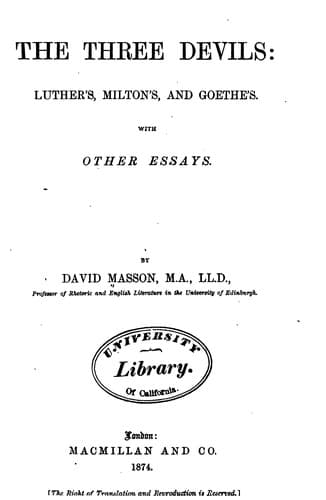
The Three Devils: Luther's, Milton's, and Goethe's; With Other EssaysMasson, David
History
The Three Devils: Luther's, Milton's, and Goethe's; With Other Essays
Masson, David
Devil in literature; Literature -- History and criticism
Dryden's connexion with the politics of the Protectorate had not been such
as to make his immediate and cordial attachment to the cause of restored
Royalty either very strange or very unhandsome. Not committed either by
strong personal convictions, or by acts, to the Puritan side, he hastened
to show that, whatever the older Northamptonshire Drydens and their
relatives might think of the matter, he, for one, was willing to be a
loyal subject of Charles, both in church and in state. This main point
being settled, he had only farther to consider into what particular walk
of industry, now that official employment under government was cut off, he
should carry his loyalty and his powers. The choice was not difficult.
There was but one career open for him, or suitable to his tastes and
qualifications--that of general authorship. We say "general authorship;"
for it is important to remark that Dryden was by no means nice in his
choice of work. He was ready for anything of a literary kind to which he
was, or could make himself, competent. He had probably a preference for
verse; but he had no disinclination to prose, if that article was in
demand in the market. He had a store of acquirements, academic and other,
that fitted him for an intelligent apprehension of whatever was going on
in any of the London circles of that day--the circle of the scholars, that
of the amateurs of natural science, or that of the mere wits and men of
letters. He was, in fact, a man of general intellectual strength, which he
was willing to let out in any kind of tolerably honest intellectual
service that might be in fashion. This being the case, he set the right
way to work to make himself known in quarters where such service was
going on. He had about 40_l._ a-year of inherited fortune; which means
something more than 120_l._ a-year with us. With this income to supply his
immediate wants, he went to live with Herringman, a bookseller and
publisher in the New Exchange. What was the precise nature of his
agreement with Herringman cannot be ascertained. His literary enemies used
afterwards to say that he was Herringman's hack and wrote prefaces for
him. However this may be, there were higher conveniences in being
connected with Herringman. He was one of the best known of the London
publishers of the day, was a personal friend of Davenant, and had almost
all the wits of the day as his customers and occasional visitors. Through
him, in all probability, Dryden first became acquainted with some of these
men, including Davenant himself, Cowley, and a third person of
considerable note at that time as an aristocratic dabbler in
literature--Sir Robert Howard, son of the Earl of Berkshire. That the
impression he made on these men, and on others in or out of the Herringman
circle, was no mean one, is proved by the fact that in 1663 we find him a
member of the Royal Society, the foundation of which by royal charter had
taken place in the previous year. The number of members was then one
Public-domain text, read in full here on John Shaqi.
Reviews
Reviews
No reviews yet
Be the first to share your thoughts on this work.
Elsewhere in the archive
Join the Discussion
Join the discussion
Sign in to leave a comment or review.
Sign InorCreate an account