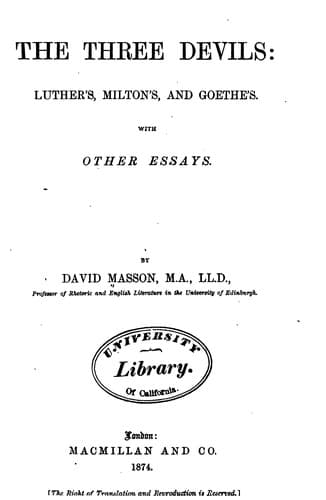
The Three Devils: Luther's, Milton's, and Goethe's; With Other EssaysMasson, David
History
The Three Devils: Luther's, Milton's, and Goethe's; With Other Essays
Masson, David
Devil in literature; Literature -- History and criticism
In consequence of the ravages of the Great Plague in 1665 and the
subsequent disaster of the Great Fire in 1666 there was for some time a
total cessation in London of theatrical performances and all other
amusements. Dryden, like most other persons who were not tied to town by
business, spent the greater part of this gloomy period in the country. He
availed himself of the interruption thus given to his dramatic labours to
produce his first writings of any moment out of that field, his _Annus
Mirabilis_ and his _Essay on Dramatic Poesy_. The first, an attempt to
invest with heroic interest, and celebrate in sonorous stanzas, the events
of the famous years 1665-6, including not only the Great Fire, but also
the incidents of a naval war then going on against the Dutch, must have
done more to bring Dryden into the favourable notice of the King, the Duke
of York, and other high personages eulogized in it, than anything he had
yet written. It was, in fact, a kind of short epic on the topics of the
year, such as Dryden might have been expected to write if he had been
already doing laureate's duty; and, unless Sir William Davenant was of
very easy temper, he must have been rather annoyed at so obvious an
invasion of his province, notwithstanding the compliment the poet had
paid him by adopting the stanza of his _Gondibert_, and imitating his
manner. Scarcely less effective in another way must have been the prose
_Essay on Dramatic Poesy_--a vigorous treatise on various matters of
poetry and criticism then much discussed. It contained, among other
things, a defence of the Heroic or Rhymed Tragedy against those who
preferred the older Elizabethan Tragedy of blank verse; and so powerful a
contribution was it to this great controversy of the day that it produced
an immediate sensation in all literary circles. Sir Robert Howard, who now
ranked himself among the partisans of blank verse, took occasion to
express his dissent from some of the opinions expounded in it; and, as
Dryden replied rather tartly, a temporary quarrel ensued between the two
brothers-in-law.
Public-domain text, read in full here on John Shaqi.
Reviews
Reviews
No reviews yet
Be the first to share your thoughts on this work.
Elsewhere in the archive
Join the Discussion
Join the discussion
Sign in to leave a comment or review.
Sign InorCreate an account