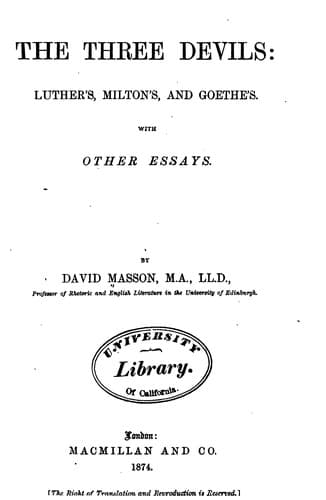
The Three Devils: Luther's, Milton's, and Goethe's; With Other EssaysMasson, David
History
The Three Devils: Luther's, Milton's, and Goethe's; With Other Essays
Masson, David
Devil in literature; Literature -- History and criticism
On the re-opening of the theatres in 1667 Dryden, his reputation increased
by the two performances just mentioned, stepped forward again as a
dramatist. A heroic tragedy called _The Indian Emperor_, which he had
prepared before the recess, and which, indeed, had then been acted, was
reproduced with great success, and established Dryden's position as a
practitioner of heroic and rhymed tragedy. This was followed by a comedy,
in mixed blank verse and prose, called _The Maiden Queen_; this by a
prose-comedy called _Sir Martin Mar-all_; and this again, by an
adaptation, in conjunction with Sir William Davenant, of Shakespeare's
_Tempest_. The two last were produced at Davenant's theatre, whereas all
Dryden's former pieces had been written for Killigrew's, or the King's
company. About this time, however, an arrangement was made which secured
Dryden's services exclusively for Killigrew's house. By the terms of the
agreement, Dryden engaged to supply the house with three plays every year,
in return for which, he was admitted a shareholder in the profits of the
theatre to the extent of one share and a-half. The first fruits of the
bargain were a prose-comedy called _The Mock Astrologer_ and two heroic
tragedies entitled _Tyrannic Love_ and _The Conquest of Granada_, the
latter being in two parts. These were all produced between 1668 and 1670,
and the tragedies, in particular, seem to have taken the town by storm,
and placed Dryden, beyond dispute, at the head of all the heroic
playwrights of the day.
The extent and nature of Dryden's popularity as a dramatist about this
time may be judged by the following extract from the diary of the
omnipresent Pepys, referring to the first performance of the _Maiden
Queen_:--"After dinner, with my wife to see the _Maiden Queene_, a new
play by Dryden, mightily commended for the regularity of it, and the
strain and wit; and the truth is, the comical part done by Nell [Nell
Gwynn], which is Florimell, that I never can hope to see the like done
again by man or woman. The King and Duke of York were at the play. But so
great a performance of a comical part was never, I believe, in the world
before as Nell do this, both as a mad girle, then most and best of all
when she comes in like a young gallant and hath the motions and carriage
of a spark the most that ever I saw any man have. It makes me, I confess,
admire her." But even Nell's performance in this comedy was nothing
compared to one part of her performance afterwards in the tragedy of
_Tyrannic Love_. Probably there was never such a scene of ecstasy in a
theatre as when Nell, after acting the character of a tragic princess in
this play, and killing herself at the close in a grand passage of heroism
and supernatural virtue, had to start up as she was being borne off the
stage dead, and resume her natural character, first addressing her bearer
in these words:--
"Hold! are you mad? you d----d confounded dog:
I am to rise and speak the epilogue.",
Public-domain text, read in full here on John Shaqi.
Reviews
Reviews
No reviews yet
Be the first to share your thoughts on this work.
Elsewhere in the archive
Join the Discussion
Join the discussion
Sign in to leave a comment or review.
Sign InorCreate an account