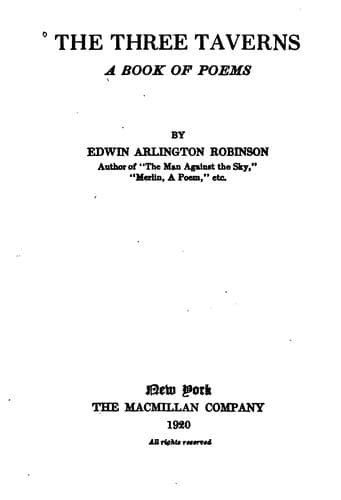
The Three Taverns: A Book of PoemsRobinson, Edwin Arlington
General
The Three Taverns: A Book of Poems
Robinson, Edwin Arlington
American poetry; Lyric poetry
We told of him as one who should have soared
And seen for us the devastating light
Whereof there is not either day or night,
And shared with us the glamour of the Word
That fell once upon Amos to record
For men at ease in Zion, when the sight
Of ills obscured aggrieved him and the might
Of Hamath was a warning of the Lord.
Assured somehow that he would make us wise,
Our pleasure was to wait; and our surprise
Was hard when we confessed the dry return
Of his regret. For we were still to learn
That earth has not a school where we may go
For wisdom, or for more than we may know.
Firelight
Ten years together without yet a cloud,
They seek each other's eyes at intervals
Of gratefulness to firelight and four walls
For love's obliteration of the crowd.
Serenely and perennially endowed
And bowered as few may be, their joy recalls
No snake, no sword; and over them there falls
The blessing of what neither says aloud.
Wiser for silence, they were not so glad
Were she to read the graven tale of lines
On the wan face of one somewhere alone;
Nor were they more content could he have had
Her thoughts a moment since of one who shines
Apart, and would be hers if he had known.
The New Tenants
The day was here when it was his to know
How fared the barriers he had built between
His triumph and his enemies unseen,
For them to undermine and overthrow;
And it was his no longer to forego
The sight of them, insidious and serene,
Where they were delving always and had been
Left always to be vicious and to grow.
And there were the new tenants who had come,
By doors that were left open unawares,
Into his house, and were so much at home
There now that he would hardly have to guess,
By the slow guile of their vindictiveness,
What ultimate insolence would soon be theirs.
Inferential
Although I saw before me there the face
Of one whom I had honored among men
The least, and on regarding him again
Would not have had him in another place,
He fitted with an unfamiliar grace
The coffin where I could not see him then
As I had seen him and appraised him when
I deemed him unessential to the race.
For there was more of him than what I saw.
And there was on me more than the old awe
That is the common genius of the dead.
I might as well have heard him: "Never mind;
If some of us were not so far behind,
The rest of us were not so far ahead."
The Rat
As often as he let himself be seen
We pitied him, or scorned him, or deplored
The inscrutable profusion of the Lord
Who shaped as one of us a thing so mean --
Who made him human when he might have been
A rat, and so been wholly in accord
With any other creature we abhorred
As always useless and not always clean.
Public-domain text, read in full here on John Shaqi.
Reviews
Reviews
No reviews yet
Be the first to share your thoughts on this work.
Join the Discussion
Join the discussion
Sign in to leave a comment or review.
Sign InorCreate an account