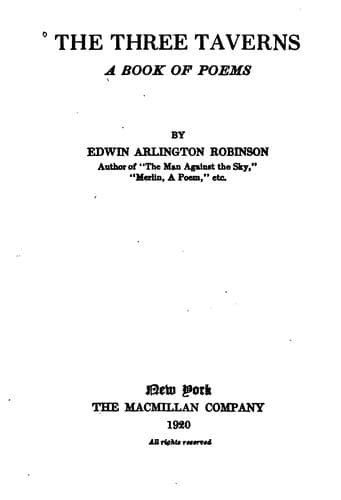
The Three Taverns: A Book of PoemsRobinson, Edwin Arlington
General
The Three Taverns: A Book of Poems
Robinson, Edwin Arlington
American poetry; Lyric poetry
Out of my screaming flesh, if only that
Would have made one man sure. I would have paid
For him the tiresome price of body and soul,
And let the lash of a tongue-weary town
Fall as it might upon my blistered name;
And while it fell I could have laughed at it,
Knowing that he had found out finally
Where the wrong was. But there was evil in him
That would have made no more of his possession
Than confirmation of another fault;
And there was honor -- if you call it honor
That hoods itself with doubt and wears a crown
Of lead that might as well be gold and fire.
Give it as heavy or as light a name
As any there is that fits. I see myself
Without the power to swear to this or that
That I might be if he had been without it.
Whatever I might have been that I was not,
It only happened that it wasn't so.
Meanwhile, you might seem to be listening:
If you forget yourself and go to sleep,
My treasure, I shall not say this again.
Look up once more into my poor old face,
Where you see beauty, or the Lord knows what,
And say to me aloud what else there is
Than ruins in it that you most admire.
No, there was never anything like that;
Nature has never fastened such a mask
Of radiant and impenetrable merit
On any woman as you say there is
On this one. Not a mask? I thank you, sir,
But you see more with your determination,
I fear, than with your prudence or your conscience;
And you have never met me with my eyes
In all the mirrors I've made faces at.
No, I shall never call you strange again:
You are the young and inconvincible
Epitome of all blind men since Adam.
May the blind lead the blind, if that be so?
And we shall need no mirrors? You are saying
What most I feared you might. But if the blind,
Or one of them, be not so fortunate
As to put out the eyes of recollection,
She might at last, without her meaning it,
Lead on the other, without his knowing it,
Until the two of them should lose themselves
Among dead craters in a lava-field
As empty as a desert on the moon.
I am not speaking in a theatre,
But in a room so real and so familiar
That sometimes I would wreck it. Then I pause,
Remembering there is a King in Weimar --
A monarch, and a poet, and a shepherd
Of all who are astray and are outside
The realm where they should rule. I think of him,
And save the furniture; I think of you,
And am forlorn, finding in you the one
To lavish aspirations and illusions
Upon a faded and forsaken house
Where love, being locked alone, was nigh to burning
House and himself together. Yes, you are strange,
To see in such an injured architecture
Room for new love to live in. Are you laughing?
No? Well, you are not crying, as you should be.
Tears, even if they told only gratitude
For your escape, and had no other story,
Were surely more becoming than a smile
For my unwomanly straightforwardness
Public-domain text, read in full here on John Shaqi.
Reviews
Reviews
No reviews yet
Be the first to share your thoughts on this work.
Join the Discussion
Join the discussion
Sign in to leave a comment or review.
Sign InorCreate an account