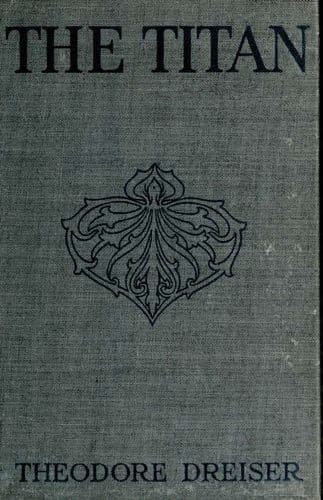
Capitalists and financiers -- Fiction; Chicago (Ill.) -- Fiction; Psychological fiction
The Hon. Chaffee Thayer Sluss, whose attitude in this instance was to
prove crucial, was a tall, shapely, somewhat grandiloquent person who
took himself and his social and commercial opportunities and doings in
the most serious and, as it were, elevated light. You know, perhaps,
the type of man or woman who, raised in an atmosphere of comparative
comfort and some small social pretension, and being short of those gray
convolutions in the human brain-pan which permit an individual to see
life in all its fortuitousness and uncertainty, proceed because of an
absence of necessity and the consequent lack of human experience to
take themselves and all that they do in the most reverential and
Providence-protected spirit. The Hon. Chaffee Thayer Sluss reasoned
that, because of the splendid ancestry on which he prided himself, he
was an essentially honest man. His father had amassed a small fortune
in the wholesale harness business. The wife whom at the age of
twenty-eight he had married—a pretty but inconsequential type of
woman—was the daughter of a pickle manufacturer, whose wares were in
some demand and whose children had been considered good “catches” in
the neighborhood from which the Hon. Chaffee Sluss emanated. There had
been a highly conservative wedding feast, and a honeymoon trip to the
Garden of the Gods and the Grand Canon. Then the sleek Chaffee, much in
the grace of both families because of his smug determination to rise in
the world, had returned to his business, which was that of a
paper-broker, and had begun with the greatest care to amass a
competence on his own account.
The Honorable Chaffee, be it admitted, had no particular faults, unless
those of smugness and a certain over-carefulness as to his own
prospects and opportunities can be counted as such. But he had one
weakness, which, in view of his young wife’s stern and somewhat
Puritanic ideas and the religious propensities of his father and
father-in-law, was exceedingly disturbing to him. He had an eye for the
beauty of women in general, and particularly for plump, blonde women
with corn-colored hair. Now and then, in spite of the fact that he had
an ideal wife and two lovely children, he would cast a meditative and
speculative eye after those alluring forms that cross the path of all
men and that seem to beckon slyly by implication if not by actual, open
suggestion.
Public-domain text, read in full here on John Shaqi.
Reviews
Reviews
No reviews yet
Be the first to share your thoughts on this work.
Elsewhere in the archive
Join the Discussion
Join the discussion
Sign in to leave a comment or review.
Sign InorCreate an account