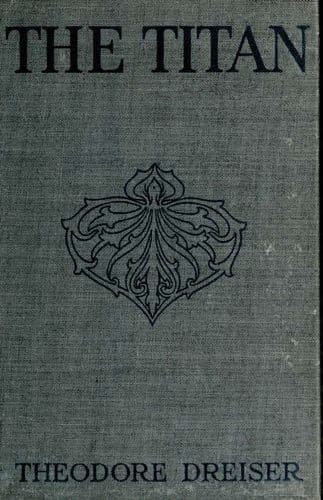
Capitalists and financiers -- Fiction; Chicago (Ill.) -- Fiction; Psychological fiction
At the thought of Mrs. Sluss—her hard, cold, blue eyes—Mr. Sluss arose,
tall and distrait, and ran his hand through his hair. He walked to the
window, snapping his thumb and middle finger and looking eagerly at the
floor. He thought of the telephone switchboard just outside his private
office, and wondered whether his secretary, a handsome young
Presbyterian girl, had been listening, as usual. Oh, this sad, sad
world! If the North Side ever learned of this—Hand, the newspapers,
young MacDonald—would they protect him? They would not. Would they run
him for mayor again? Never! Could the public be induced to vote for him
with all the churches fulminating against private immorality,
hypocrites, and whited sepulchers? Oh, Lord! Oh, Lord! And he was so
very, very much respected and looked up to—that was the worst of it
all. This terrible demon Cowperwood had descended on him, and he had
thought himself so secure. He had not even been civil to Cowperwood.
What if the latter chose to avenge the discourtesy?
Mr. Sluss went back to his chair, but he could not sit in it. He went
for his coat, took it down, hung it up again, took it down, announced
over the ’phone that he could not see any one for several hours, and
went out by a private door. Wearily he walked along North Clark Street,
looking at the hurly-burly of traffic, looking at the dirty, crowded
river, looking at the sky and smoke and gray buildings, and wondering
what he should do. The world was so hard at times; it was so cruel. His
wife, his family, his political career. He could not conscientiously
sign any ordinances for Mr. Cowperwood—that would be immoral,
dishonest, a scandal to the city. Mr. Cowperwood was a notorious
traitor to the public welfare. At the same time he could not very well
refuse, for here was Mrs. Brandon, the charming and unscrupulous
creature, playing into the hands of Cowperwood. If he could only meet
her, beg of her, plead; but where was she? He had not seen her for
months and months. Could he go to Hand and confess all? But Hand was a
hard, cold, moral man also. Oh, Lord! Oh, Lord! He wondered and
thought, and sighed and pondered—all without avail.
Pity the poor earthling caught in the toils of the moral law. In
another country, perhaps, in another day, another age, such a situation
would have been capable of a solution, one not utterly destructive to
Mr. Sluss, and not entirely favorable to a man like Cowperwood. But
here in the United States, here in Chicago, the ethical verities would
all, as he knew, be lined up against him. What Lake View would think,
what his pastor would think, what Hand and all his moral associates
would think—ah, these were the terrible, the incontrovertible
consequences of his lapse from virtue.
Public-domain text, read in full here on John Shaqi.
Reviews
Reviews
No reviews yet
Be the first to share your thoughts on this work.
Elsewhere in the archive
Join the Discussion
Join the discussion
Sign in to leave a comment or review.
Sign InorCreate an account